Explainer
Wall Folding Table Sizes: Depth, Width and How Many People Fit
Most wall-mounted folding tables are 15 to 16 inches deep – one place setting – and 24 to 47 inches wide. Tables sold for two, such as the COSTWAY drop-leaf and IKEA's NORBERG, are about 23½ inches deep. The NKBA kitchen guidelines allow 24 inches of table edge and 18 inches of knee depth per diner at a 30-inch table, so by that yardstick no wall table in our data seats four.
Disclosure: This page contains affiliate links (marked with *). If you buy through them, we earn a small commission at no extra cost to you. As an Amazon Associate I earn from qualifying purchases. Learn more
The short version
Depth decides the use: 15 to 16 inches is a one-plate ledge, about 23½ inches is the depth makers sell for two. Width decides how many sit side by side: the NKBA kitchen guidelines allow 24 inches of edge per diner, so two people side by side need about 48 inches. Plan about 32 inches of free floor behind each seat. None of the wall tables in our data seats four.
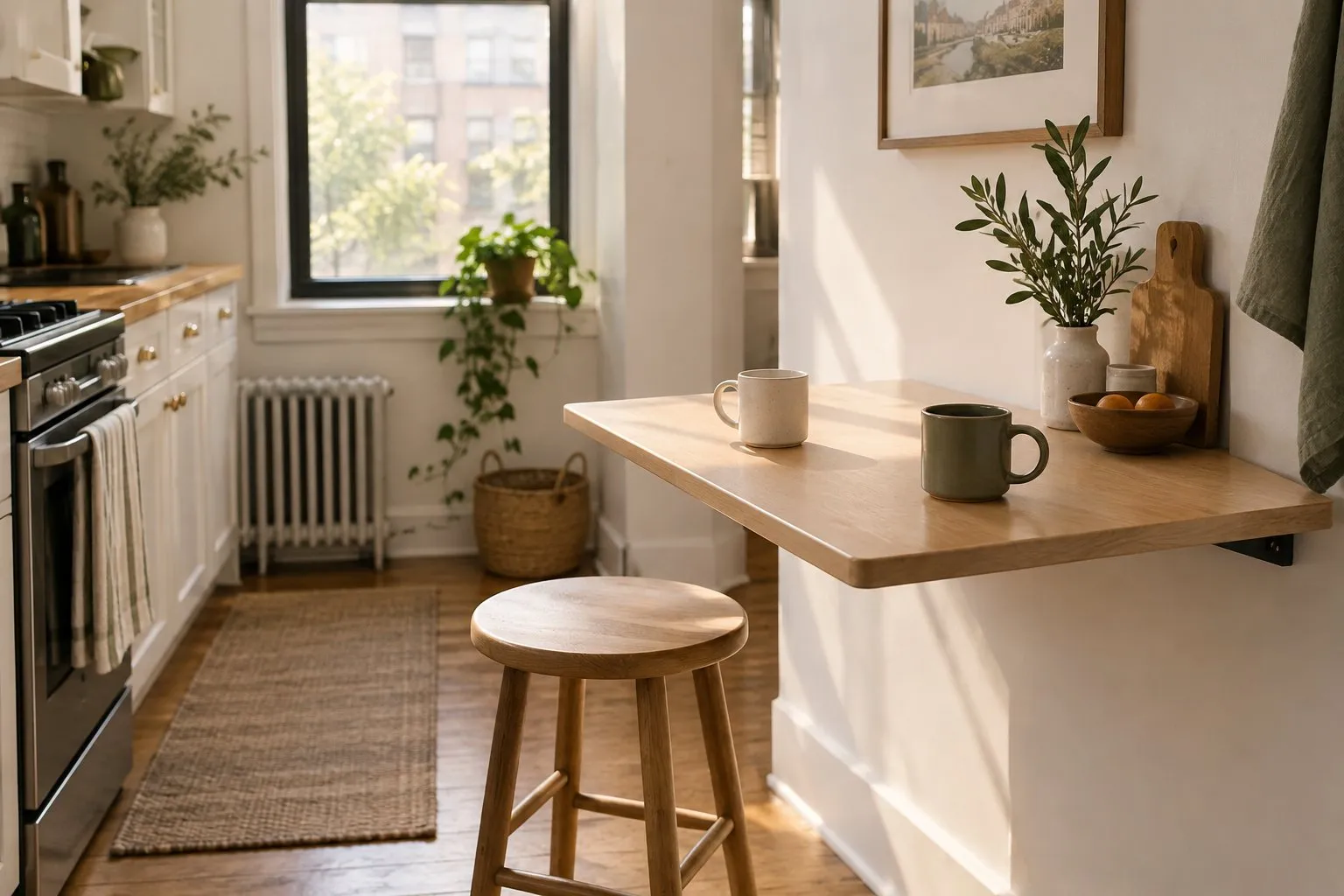
The short answer in three numbers
- Depth: 15 to 16 inches is one place setting. About 23½ inches is the depth the makers in our data sell for two.
- Width: about 24 inches of free edge per person, by the NKBA kitchen guidelines. Two people side by side need about 48 inches.
- Floor: about 32 inches behind each seat when no one passes, more when people walk behind.
Everything else – the bracket spacing, the studs, the height – follows from the top you choose. Start with depth, because it decides what the table is for.
Depth: one plate or two
The depth is the distance from the wall to the front edge of the open top. These are the open sizes in our data and what the source says the table is for:
| Table | Open size (width x depth) | Source | Use |
|---|---|---|---|
| IKEA ASKHOLMEN (outdoor) | 27½ x 17⅜ in | IKEA US | balcony, IKEA says seats 2 |
| MM MELISEN solid wood | 23.6 x 15.7 in | listing | one place setting |
| Neoaider | 31.5 x 15.7 in | listing | breakfast ledge |
| Mount-It! MI-7993 | 45 x 15 in or 30 x 15 in | Mount-It! | long, light top |
| VIVO workbench | 43.3 x 18 in | VIVO | workbench |
| IKEA BJURSTA | about 35⅜ x 19¾ in | IKEA | IKEA says seats 2 |
| Need | 47 x 20 in | listing | long top, two side by side |
| COSTWAY drop-leaf | 31.5 x 23.5 in | Costway | dining for two |
| IKEA NORBERG | about 29⅛ x 23⅝ in | IKEA | IKEA says seats 2 |
| Lifetime 80421 | 47 x 23.3 in work surface | Home Depot spec sheet | work table with legs |
A pattern stands out: most fold-down tops are 15 to 18 inches deep. That is a ledge for one person facing the wall, or for several people side by side on a long top. The tops sold for two facing each other cluster around 23½ inches.
How many people fit: the NKBA yardstick
There is no standard for wall tables, and NKBA does not say how many people a given table seats. The closest planning source is the National Kitchen & Bath Association's Kitchen Planning Guidelines. Guideline 9 recommends, at 30-inch-high tables and counters, a knee space 24 inches wide and 18 inches deep for each seated diner. Applied by us to a wall table, that gives a simple calculation:
| Seating | NKBA's per-diner knee space applied (our calculation) | Tables in our data that meet it |
|---|---|---|
| One person facing the wall | 24 in of edge, 18 in of depth | VIVO, Need, COSTWAY, NORBERG, BJURSTA; the 15- to 16-inch ledges fall short in depth |
| Two side by side, facing the wall | 48 in of edge, 18 in of depth | none quite: Need and GOYLSER are 47 in, Lifetime 47 in |
| Two facing each other at the ends | 36 in of width (18 + 18), 24 in of depth | none: COSTWAY 31.5 x 23.5, BJURSTA 35⅜ x 19¾ |
| Four people | about 96 in of free edge | none |
So when Costway or IKEA say “for two”, that is the maker's count; by the NKBA knee-space figures it is a compact two-seater – fine for breakfast or a small dinner, tight for a long meal. Four people at a wall table is not realistic with any model we know; a wall table has one long side against the wall, and the largest tops in our data are about 47 inches wide.
NKBA's access recommendation goes further for people of different sizes or using a mobility aid: seating areas 30 to 36 inches wide and 17 to 25 inches deep, with a knee space of at least 36 x 27 x 17 inches. The 2010 ADA Standards, written for public and commercial buildings, require knee clearance at least 30 inches wide (306.3.5) and a clear floor space of 30 x 48 inches in front of an accessible dining or work surface (305.3, 902.2).
Floor space in front of the table
A fold-down table saves floor only when it is closed. Open, it needs the top plus the chair. NKBA Guideline 8 recommends 32 inches from the table edge to a wall or other obstacle behind a seated diner when no traffic passes, 36 inches if someone has to edge past and 44 inches to walk past.
| Open depth | No one passing | Someone edges past | Someone walks past |
|---|---|---|---|
| 15.7 in (Neoaider) | about 48 in from the wall | about 52 in | about 60 in |
| 18 in (VIVO) | about 50 in | about 54 in | about 62 in |
| 23.5 in (COSTWAY) | about 55½ in | about 59½ in | about 67½ in |
Measure that distance in your kitchen or hallway before you choose the depth. A deep top in a narrow galley can block the room when it is open. The kitchen and dining guide compares the tables for this situation.
Folded depth
Closed, the table stays on the wall all day. The makers state: VIVO 2.3 inches, Costway 3.0 inches (folded size 31.5 x 21 x 3.0 inches), IKEA BJURSTA about 4 inches (10 cm minimum depth). Furniture with a fold-out top is much deeper: IKEA lists the BILLY bookcase with foldable table at 12¾ inches folded. Cabinet-style Murphy tables also stand deeper, because the cabinet surrounds the top; the comparison of wall table types shows the designs side by side.
Width and the studs behind it
Width also decides how the table is fixed. Wood studs are 16 or 24 inches on center, and each bracket needs a stud or a ledger board across studs. A 24-inch top may reach only one stud on a 24-inch wall; a 31.5-inch top covers one or two studs at either spacing, depending on where they fall. The question are studs 16 or 24 inches apart explains how to check. A deeper top also pulls harder on its upper screws, because the load sits further from the wall – so a bigger table asks more of the fixing, as the page on weight capacity explains.
Height belongs to the size, too
For meals and seated work, put the top edge at about 29 to 30 inches; the 2010 ADA Standards set 28 to 34 inches for dining and work surfaces (902.3), and NKBA's seating figures above refer to 30-inch tables. Bar-height tables follow the stool; the guide to mounting height has the figures.
Our pick for two
COSTWAY Drop-Leaf 31.5 x 23.5
A drop-leaf top deep enough for two place settings that folds to 3 inches against the wall.
Why here: The deepest top for two in our data with maker data: 31.5 x 23.5 inches open, 3.0 inches folded, 66 lb maximum according to Costway (wall not named).
Best for: Small kitchens and studios where two people eat or work at the wall
- 23.5 in deep when open – room for two plates facing each other
- Folded size 31.5 x 21 x 3.0 in according to Costway
- Two ways to fold: drop one leaf or both
- Maker states a 66 lb maximum load
- Costway does not say which wall or fasteners the 66 lb rating assumes
- The supplied expansion screws are generic – plan your own fasteners for studs or masonry
- MDF top: wipe spills, do not leave it wet
- Type
- Drop-leaf top on a wooden support
- Top size
- 31.5 x 23.5 in (open)
- Folded depth
- 3.0 in (Costway)
- Load rating
- 66 lb max (Costway)
- Mounting
- Hinges and screws; studs not mentioned
- Material
- P2 MDF, pine, metal hinges
The longest tops are compared on the page about large wall folding tables, the shortest under small wall folding tables. Questions about mounting and walls are collected under questions and answers; more guides start on the homepage.
Questions people ask
Can a wall-mounted folding table seat four people?
Not any table in our data. The NKBA kitchen guidelines allow a 24-inch-wide knee space per diner at a 30-inch table, so four diners need about 96 inches of free table edge, and a wall table has one long side against the wall. The largest tops we have are about 47 inches wide and 20 to 23 inches deep. For four, a freestanding table is the realistic choice.
How deep should a fold-down table be for two people?
The tables makers sell for two are about 23½ inches deep: COSTWAY 23.5 inches, IKEA NORBERG 23⅝ inches. IKEA also lists BJURSTA, 19¾ inches deep, for two. That is compact: NKBA Guideline 9 plans a knee space 24 inches wide and 18 inches deep per diner at a 30-inch table. NKBA says nothing about wall tables; applied by us to two people sitting at the two ends of a wall table, that adds up to about 36 inches of width and 24 inches of depth. A 15- to 16-inch top is one plate deep.
How much space do I need in front of a wall table?
Add the open depth of the top to the room behind the chair. The NKBA guidelines recommend 32 inches from the table edge to a wall or obstacle behind a seated diner when no one passes, 36 inches for someone to edge past and 44 inches to walk past. For a 23.5-inch top with nobody passing, that is about 55½ inches from the wall.
What size is a typical wall-mounted folding desk?
In our data, wall desks run from about 31.5 inches wide for laptop desks to 48 x 16 inches for a wide fold-down desk. A 16-inch depth holds a laptop and papers; check that a monitor fits before you buy. Seated work belongs at the same 28 to 34 inches the ADA Standards give for work surfaces.
Sources
- NKBA: Kitchen Planning Guidelines (Guideline 8 traffic clearance at seating, Guideline 9 seating clearance), PDF
- U.S. Access Board: 2010 ADA Standards, 305 Clear floor space, 306 Knee clearance, 902 Dining and work surfaces
- IKEA (Canary Islands, English): NORBERG wall-mounted drop-leaf table – 74 x 60 cm, seats 2
- IKEA Türkiye (English): BJURSTA wall-mounted drop-leaf table – 90 x 50 cm, seats 2
- Costway: 31.5 x 23.5 Inch Folding Wall Mounted Table for Small Spaces (maker page)
- VIVO: Wall Mounted 43 x 18 inch Folding Workbench, MOUNT-SF1FB (maker page)
Keep reading
- Buying guideKitchen & diningWall-mounted folding dining and kitchen tables compared: which top is deep enough for two, how far it folds, what the load rating assumes and how to mount it.
- ExplainerMounting heightWall-mounted folding table height: 28 to 34 inches for dining and desks per ADA 902.3, IKEA's bar heights, and why laundry height has no official number.
- Buying guideDrop-leaf tablesWall-mounted drop-leaf tables compared: how the fixed strip and hinged leaf work, which model seats two, folded depth, load ratings and how to mount one safely.
- ComparisonTable types comparedFour wall-table designs compared – folding brackets, drop-leaf, Murphy table and fold-out legs – plus how a gateleg table differs, with what carries the load.
- Question & answerAre Studs 16 or 24 Inches Apart, and How Does That Limit Where Your Table Can Go?Wood studs can be 16 or 24 inches on center. What the residential code table says, how to measure your wall and when a fold-down table needs a ledger board.
Who writes here
wallmountedfoldingtable.com Editorial Team
Fold-down tables, desks & workbenches
We are the editorial team at wallmountedfoldingtable.com. We compare maker spec sheets, manuals, retailer data, building codes and anchor data for wall-mounted folding tables and turn them into plain-English advice – with sources on every page. We do not run lab tests or load tests, and we say so openly.
- Maker specs, manuals & codes compared
- Sources on every page
- No lab tests – stated openly
- Publisher details in the imprint