Question & answer
Can You Mount a Fold-Down Table on Drywall Without Studs?
Not on drywall anchors alone. A fold-down table pulls hard on its top screws, and drywall is the weak link. If no stud sits where a bracket has to go, the fix is a ledger board: a horizontal board screwed across at least two studs, with the table mounted on the board.
The short answer
Not on hollow-wall anchors alone. An open fold-down table pulls on its top screws, and anchors carry only a fraction of their rating: TOGGLER's sheet notes that industry standards recommend one quarter of the ultimate test load. If no stud sits where a bracket goes, screw a ledger board across at least two studs and mount the table on it, following the table maker's instructions.
Why drywall alone is the weak point
An open fold-down table works like a lever. Whatever sits on the top pushes down at some distance from the wall, and the brackets turn that into a pull on the upper screws. The deeper the top and the further out the load, the harder those screws are pulled out of the wall. In a drywall wall without a stud, the only thing resisting that pull is the gypsum board around the anchor.
TOGGLER's technical sheet for its SNAPTOGGLE hollow-wall anchors shows what that means in numbers. For the 1/4-inch (M6) anchor in 1/2-inch drywall it lists about 120 kg (265 lb) ultimate tension, and it notes that industry standards recommend one quarter of the ultimate test load as the working load: about 30 kg (66 lb) per anchor. TOGGLER measures failure in drywall as the board starting to gouge or break, and it says holding strength drops as the load moves further from the wall. The figures are guides from lab tests; the age and condition of your wall count as well.
So the question is not whether an anchor can hold a table in a lab. It is whether the drywall around it can take the pull of a loaded top every day, for years. None of the table makers we read relies on that: VIVO names wood stud, brick or concrete for its workbench, and Lifetime designed its work table to fit 16-inch stud spacing. Costway and Mount-It! do not name a wall type at all. Why load figures need a wall behind them is explained on the page about weight capacity.
The fix: a ledger board across the studs
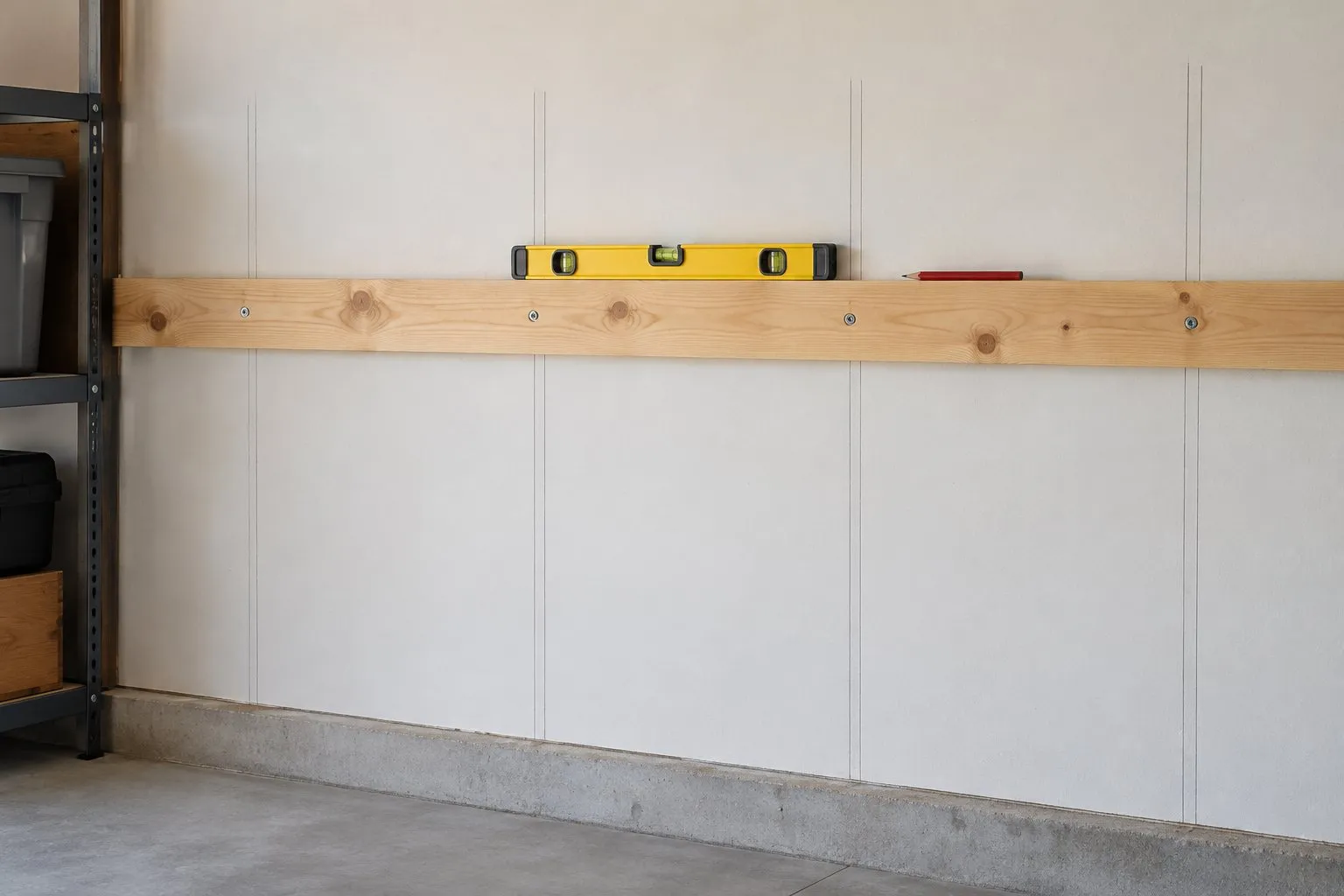
A ledger board is a horizontal board screwed into at least two studs. The table brackets are then fixed to the board, wherever they need to sit. The board spreads the load of the table onto the studs, so the drywall carries nothing.
- Find and mark the studs with a stud finder. Wood studs are 16 or 24 inches on center, depending on stud size and load (IRC Table R602.3(5)), so do not assume 16 inches.
- Plan the board long enough to reach at least two studs and wide enough for the bracket plates.
- Mark the height. For meals, the top edge belongs at about 29 to 30 inches; the bracket position follows from the table's manual.
- Screw the board into every stud it crosses, level, with screws long enough to reach well into the studs. If you are unsure about screw type or length, ask a contractor.
- Fix the brackets to the board as the table maker's instructions describe.
The full procedure is in the guide on how to install a wall-mounted folding table. The check below shows whether two brackets can sit directly on studs for a given top width; if they cannot, the ledger is the answer.
Stud span check
Enter the width of the top and the stud spacing of your wall.
Depending on where you place it, the top spans 1 to 2 studs.
Fewer than two studs are guaranteed: plan a ledger board that spans at least two studs.
Pure geometry from the stud spacing. Find the actual studs in your wall with a stud finder before drilling.
Other walls
- Steel studs: TOGGLER lists separate values for drywall with a 25-gauge steel stud. Follow both the table maker's and the anchor maker's instructions, or ask a contractor.
- Brick and concrete: VIVO names brick and concrete as suitable walls for its workbench. Use the masonry anchors the instructions call for.
- Plaster and lath: we have not researched this wall type yet. Ask a contractor before you mount a table on it.
What to buy
Whichever table you pick from our comparison of the best wall-mounted folding tables, check its instructions for how it may be fixed to a ledger board. Note that the makers' load ratings assume a sound wall; they do not cover drywall alone. More questions are collected under questions and answers, and the basics start on the homepage.
Questions people ask
Can I use toggle bolts for a wall-mounted folding table?
None of the table makers we read names hollow-wall anchors as a mounting for their table: VIVO names wood stud, brick or concrete, and Lifetime designed its work table for 16-inch stud spacing. TOGGLER's sheet lists about 265 lb ultimate tension for a 1/4-inch SNAPTOGGLE in 1/2-inch drywall, but industry standards recommend only one quarter of that. Use studs or a ledger board instead.
What if there is only one stud where I want the table?
Then screw a ledger board across that stud and the next one, or across more studs for a wider top, and fix the table brackets to the board. Wood studs are 16 or 24 inches on center, so the board has to be at least long enough to reach two of them. A contractor can help if you are unsure about the screws.
Do adhesive strips work for a wall table?
No. Adhesive strips and tension rods are no mounting method for a load-bearing wall table. Every product we compared mounts with screws; one Neoaider listing says six screws go into the wall. If you rent, ask your landlord for written permission before you drill.
Sources
- TOGGLER: SNAPTOGGLE technical bulletin (ultimate loads, 1/4 working-load note)
- 2012 Seattle Residential Code, Chapter 6, Table R602.3(5) Size, height and spacing of wood studs (IRC-based)
- VIVO: Wall Mounted 43 x 18 inch Folding Workbench, MOUNT-SF1FB (maker page, wall types)
- Lifetime: Wall-Mounted Work Table 80421 (maker page, 16-inch stud spacing)
Keep reading
- How-toHow to installInstall a wall-mounted folding table safely: find the studs, mark the top edge, drill per the manual and use a ledger board when the brackets miss a stud.
- ExplainerWeight capacityHow much weight a wall-mounted folding table can hold: maker load ratings from 33 to 150 lb, what the wall and anchors add, and why leverage limits the load.
- ComparisonAll tables comparedThe best wall-mounted folding tables, desks and workbenches side by side: top size, load rating with the mounting it assumes, folded depth and maker sources.
- OverviewQuestions & answersShort, sourced answers to the questions people ask before and after buying a wall-mounted folding table: walls, studs, brackets, rentals, load and height.
Who writes here
wallmountedfoldingtable.com Editorial Team
Fold-down tables, desks & workbenches
We are the editorial team at wallmountedfoldingtable.com. We compare maker spec sheets, manuals, retailer data, building codes and anchor data for wall-mounted folding tables and turn them into plain-English advice – with sources on every page. We do not run lab tests or load tests, and we say so openly.
- Maker specs, manuals & codes compared
- Sources on every page
- No lab tests – stated openly
- Publisher details in the imprint