Question & answer
Are Studs 16 or 24 Inches Apart, and How Does That Limit Where Your Table Can Go?
Both. Wood studs in US houses are 16 or 24 inches on center, and the residential code table allows 24 inches for many walls. For a fold-down table that decides whether both brackets can land on studs, how wide the top has to be to reach two studs, and whether you need a ledger board first.
Disclosure: This page contains affiliate links (marked with *). If you buy through them, we earn a small commission at no extra cost to you. As an Amazon Associate I earn from qualifying purchases. Learn more
The short answer
Wood studs are 16 or 24 inches on center: the IRC table on stud size and spacing allows up to 24 inches for 2x4 studs that carry only a roof and ceiling and for nonbearing walls, and 16 inches for 2x4 studs under a floor. Measure your wall. If the bracket spacing of your table is not a multiple of your stud spacing, mount a ledger board across the studs first.
What the code table says
Stud spacing in US wood-frame houses follows the International Residential Code. Its Table R602.3(5), “Size, height and spacing of wood studs”, gives the maximum spacing for each stud size and load. We read it in the 2012 Seattle Residential Code, which reproduces the IRC text:
| Stud size | Bearing wall, roof and ceiling only | Bearing wall, one floor plus roof | Nonbearing wall |
|---|---|---|---|
| 2x3 | not allowed | not allowed | 16 in |
| 2x4 | 24 in | 16 in | 24 in |
| 2x6 | 24 in | 24 in | 24 in |
The table lists maximums, so a builder may always place studs closer. That is why 16 inches is common, but nothing in the code makes it the rule: an interior partition or the wall of a one-story house or a garage may legally have studs 24 inches on center. Older houses and remodeled walls can differ again. The only reliable figure is the one you measure on your own wall.
Why the spacing decides where the table goes
A fold-down table hangs on two brackets, and each bracket needs its screws in the middle of a stud (or in solid masonry). That gives three simple checks:
- Bracket spacing. Both brackets can sit on studs only if their distance is a multiple of the stud spacing: 16, 32 or 48 inches on a 16-inch wall, 24 or 48 inches on a 24-inch wall.
- Top width. A top covers at least as many studs as its width divided by the spacing, rounded down, and at most one more. A 32-inch top always reaches two studs at 16 inches; at 24 inches it reaches one for sure and a second only if it is placed well.
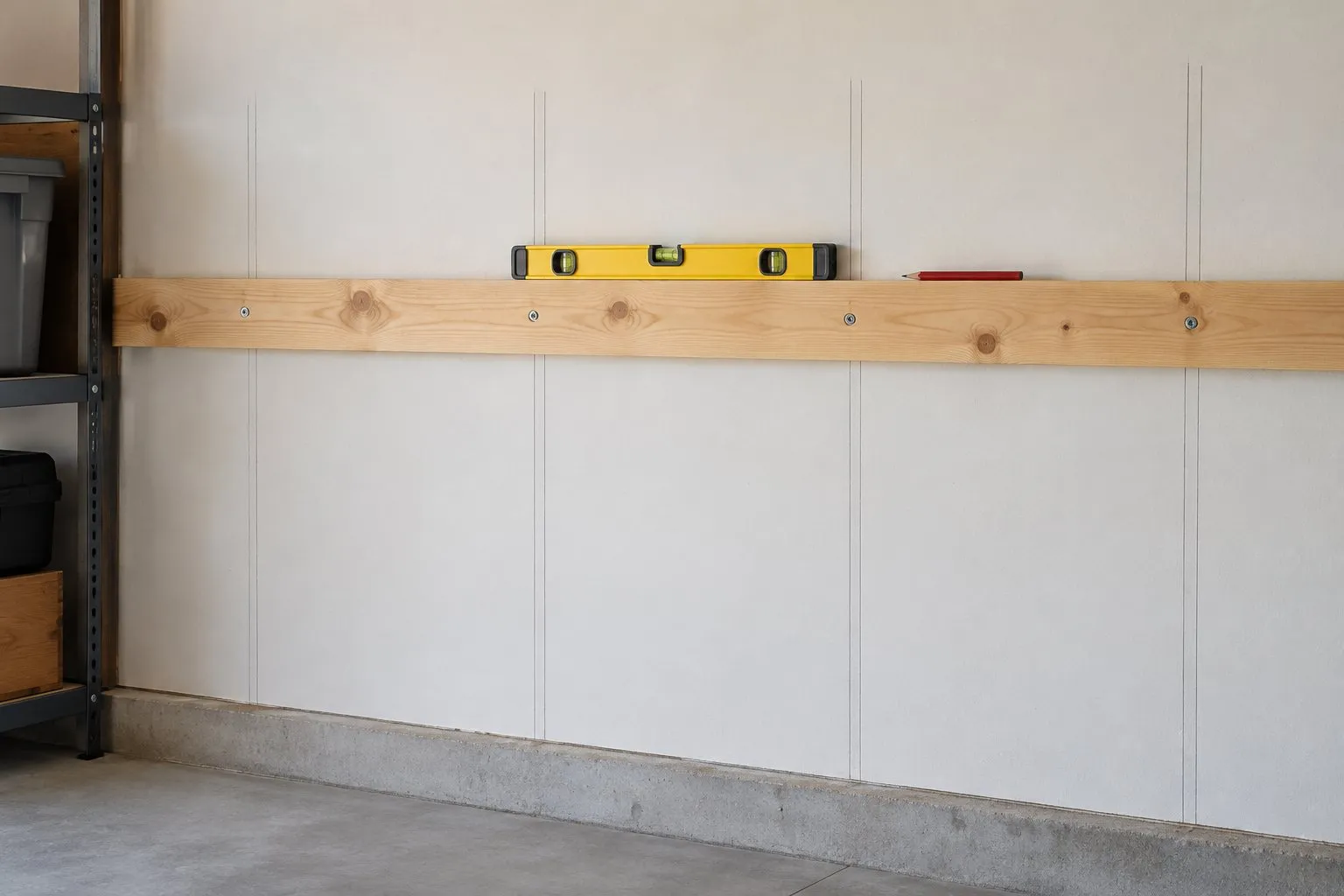
- Position. The studs decide where the table sits sideways. If that clashes with a window, an outlet or the middle of the wall you wanted, a ledger board lets you shift the table.
The check below runs these numbers for your top and wall.
Stud span check
Enter the width of the top and the stud spacing of your wall.
Depending on where you place it, the top spans 1 to 2 studs.
Fewer than two studs are guaranteed: plan a ledger board that spans at least two studs.
Pure geometry from the stud spacing. Find the actual studs in your wall with a stud finder before drilling.
How the makers handle it
The makers we read solve the problem in different ways, and the difference matters when you shop:
- Lifetime 80421: the mounting bracket of this work table is built for 16-inch studs. Its manual says the two outer oval holes sit 16 inches from the center hole, adds extra holes on each side for variations in stud distance, and notes that three studs are best but two will do. The manual does not describe a 24-inch wall, so on such a wall hold the bracket against your marked studs and check which holes meet a stud center before you order or drill. The Lifetime work table page has the details.
- Mount-It! MI-7993: the folding arms are screwed under the top wherever you place them. The manual tells you to set the distance between the arms equal to the distance between two stud centers, so the table adapts to 16- or 24-inch walls.
- VIVO MOUNT-SF1FB: VIVO's manual aligns only three vertical holes of each bracket with the center of a stud and leaves the other three unused. It does not name a stud spacing.
When a ledger board is the answer
If the brackets cannot reach two studs, screw a horizontal ledger board into at least two studs and fix the brackets to the board. The board must be long enough to cross the studs and thick enough for the bracket screws the manual names. How to plan and fix it is in the guide on how to install a wall-mounted folding table, and the question can you mount a fold-down table on drywall without studs explains why hollow-wall anchors are no substitute.
Stud spacing also limits how deep and how heavily loaded the top can be, because the screws in the studs take the pull of the open top. Why that matters more than the printed rating is explained under weight capacity, and which bracket length suits which top is answered in what bracket length a 24-inch-deep table needs.
A table whose maker names the wall
VIVO 43 x 18 Workbench
A 43-inch workbench top on steel brackets that folds to 2.3 inches from the wall.
Why here: VIVO names wood stud, brick or concrete for its 110 lb rating and says exactly which bracket holes go into the stud center.
Best for: Garages and basements with wood studs, brick or concrete walls
- VIVO names the wall types: wood stud, brick or concrete
- 110 lb capacity stated by the maker
- Folds to 2.3 in from the wall
- 3-year warranty (VIVO)
- Particle board top – not for wet work or heavy pounding
- Type
- Top on folding steel brackets
- Top size
- 43.3 x 18 x 1 in
- Load rating
- 110 lb (VIVO)
- Mounting
- Wood stud, brick or concrete (VIVO)
- Folded depth
- 2.3 in (VIVO)
- Warranty
- 3 years (VIVO)
All tables, desks and benches with their stated mounting are in the comparison of wall-mounted folding tables. More short answers are collected under questions and answers.
Questions people ask
How do I find out whether my studs are 16 or 24 inches apart?
Mark the edges of two neighboring studs with a stud finder, mark the center of each and measure from center to center. Check a third stud, because the first stud next to a corner, door or window often sits at an odd distance. If the readings stay unclear, ask a contractor before you drill the final holes.
Does a 24-inch-wide table fit on 24-inch studs?
Only by chance. A 24-inch top on studs 24 inches on center covers one stud for sure and a second only if its edges line up with two stud centers – and the brackets sit inside the top, not at its edges. In practice you mount a ledger board across two studs and screw the brackets to the board.
Can I just move the brackets to match my studs?
Often yes, if the top is a separate board. Mount-It! tells you to place the folding arms under its top so that their distance equals the distance between two stud centers, and VIVO screws only one row of bracket holes into the stud center. Units with a fixed frame, such as the Lifetime 80421, are built around 16-inch spacing.
Sources
Keep reading
- How-toHow to installInstall a wall-mounted folding table safely: find the studs, mark the top edge, drill per the manual and use a ledger board when the brackets miss a stud.
- Question & answerCan You Mount a Fold-Down Table on Drywall Without Studs?Can a fold-down wall table hang on drywall without studs? Why hollow-wall anchors are the weak point, and how a ledger board across the studs solves it.
- Question & answerWhat Bracket Length Does a 24-Inch-Deep Fold-Down Table Need?Which folding bracket length suits a 24-inch-deep fold-down top, why the arm must not reach past the front edge, and what a shorter arm changes for the top.
- ExplainerWeight capacityHow much weight a wall-mounted folding table can hold: maker load ratings from 33 to 150 lb, what the wall and anchors add, and why leverage limits the load.
- OverviewQuestions & answersShort, sourced answers to the questions people ask before and after buying a wall-mounted folding table: walls, studs, brackets, rentals, load and height.
Who writes here
wallmountedfoldingtable.com Editorial Team
Fold-down tables, desks & workbenches
We are the editorial team at wallmountedfoldingtable.com. We compare maker spec sheets, manuals, retailer data, building codes and anchor data for wall-mounted folding tables and turn them into plain-English advice – with sources on every page. We do not run lab tests or load tests, and we say so openly.
- Maker specs, manuals & codes compared
- Sources on every page
- No lab tests – stated openly
- Publisher details in the imprint