Comparison
Folding Wall Table vs. Drop-Leaf vs. Murphy Table vs. Gateleg: Which Design Fits
Wall-mounted folding tables come in four designs: a top on folding brackets, a drop-leaf with a fixed strip and a hinged leaf, a Murphy-style table that closes into a cabinet or panel, and a work table with fold-down legs. A gateleg table is the freestanding relative: its leaves rest on legs that swing out like a gate. What separates them is what carries the open top – the wall, a cabinet or the floor.
Disclosure: This page contains affiliate links (marked with *). If you buy through them, we earn a small commission at no extra cost to you. As an Amazon Associate I earn from qualifying purchases. Learn more
The short version
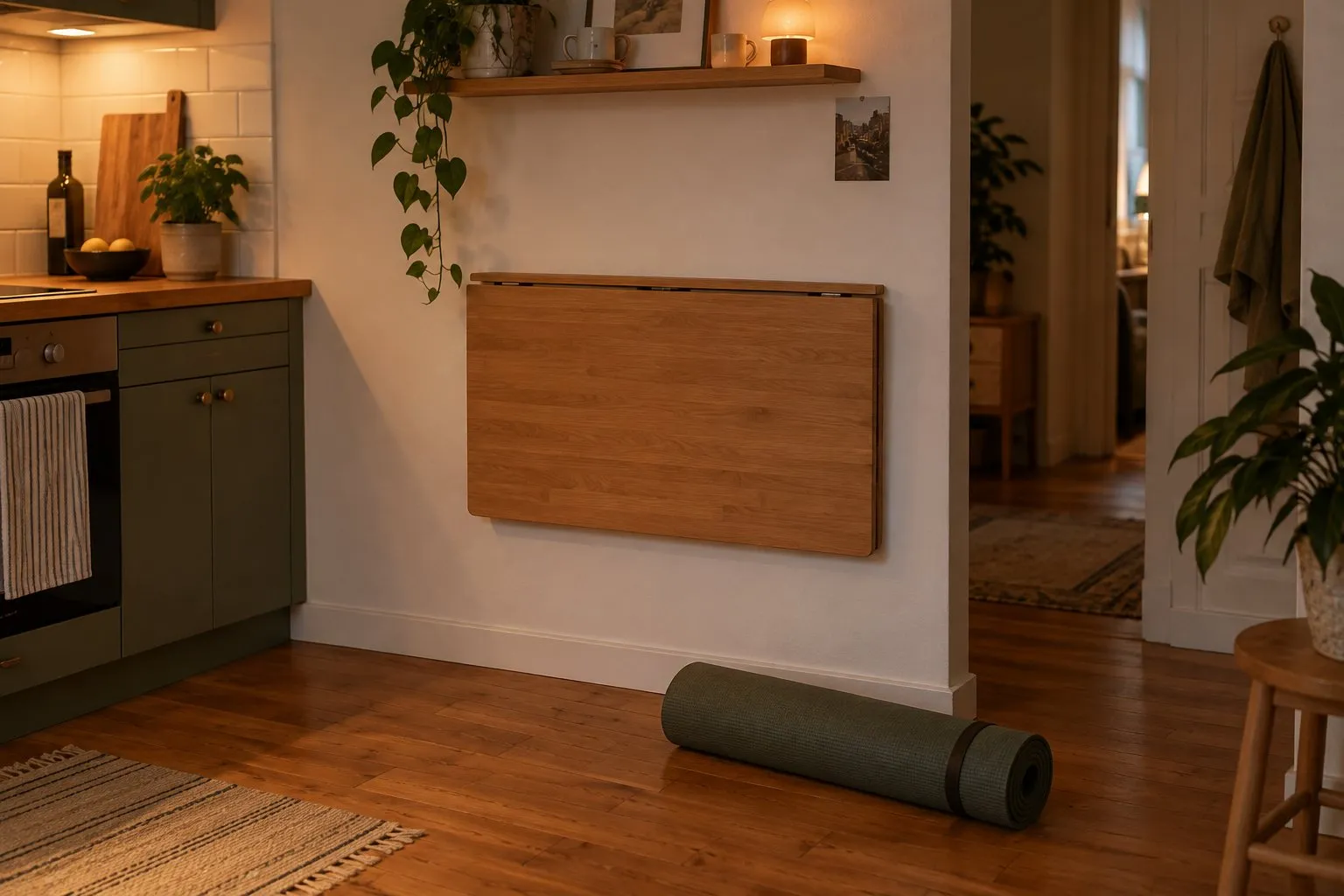
Choose folding brackets for a simple top that folds flat (VIVO: 2.3 in folded), a drop-leaf for a dining spot that folds in stages (COSTWAY: 31.5 x 23.5 in, 3.0 in folded), a Murphy-style table if the folded table should disappear into a cabinet or panel, and fold-down legs when the front edge needs support from the floor, as on the Lifetime 80421. A gateleg table is freestanding.
Short verdict
For a kitchen or studio where two people eat at the wall, a drop-leaf is the most practical design: it folds in stages and gives the most depth for little wall. For a garage, laundry or hobby wall, a top on folding brackets is simpler and folds flattest. A Murphy-style table is the choice when the closed table should look like a cabinet or a panel rather than a folded board. Fold-down legs are worth it when the top is big or heavily loaded. A gateleg is not a wall table at all.
The five designs side by side
| Design | How it folds | What carries the open top | Example from our data | Best for |
|---|---|---|---|---|
| Top on folding brackets | the whole top drops and hangs flat against the wall | two locking brackets screwed into the wall | VIVO 43 x 18: 2.3 in folded, 110 lb on wood stud, brick or concrete | garage, laundry, hobby, a simple desk |
| Drop-leaf | a narrow strip stays fixed, the hinged leaf drops | the fixed strip and a support under the leaf | COSTWAY 31.5 x 23.5: 3.0 in folded, 66 lb (no wall named) | dining for two, small kitchens |
| Murphy table | the top closes into a shallow cabinet or flat panel | cabinet frame, often with a stay or leg | few true examples on Amazon | dining spot that should vanish behind a front |
| Work table with fold-down legs | top folds up, legs fold with it | the wall at the back, the legs at the front | Lifetime 80421: 150 lb (Home Depot spec sheet) | heavy garage work, standing height |
| Gateleg (freestanding) | leaves drop on both sides of a fixed center | legs that swing out like a gate | – | dining rooms, not wall-mounted |
The differences point by point
Folding brackets: simplest and flattest
A plain top sits on two locking brackets. Lift it and the arms lock square; squeeze the release and the top hangs down against the wall. Because there is no fixed strip, the folded table can be very slim: VIVO states 2.3 inches from the wall for its workbench. The downside is that the whole load goes through two brackets into the wall, so both need studs, a ledger board or masonry. You can also build this design yourself with folding shelf brackets.
Drop-leaf: depth for two, in stages
Wikipedia defines a drop-leaf table as a table with a fixed section and a hinged leaf on either side; on a wall version, one fixed strip is screwed to the wall and the leaf folds up onto a support. The COSTWAY table shows why the design suits small kitchens: it is 23.5 inches deep when open, enough for two plates facing each other, and you can drop one leaf or both, according to Costway. The fixed strip adds a little folded depth – 3.0 inches here. Details and alternatives are on the page about wall-mounted drop-leaf tables.
Murphy table: a table behind a front
A Murphy table is a fold-down table, usually for dining, that closes into a wall cabinet or a flat panel. The name borrows from the Murphy bed, which Wikipedia describes as a bed hinged at one end so it can be stored vertically against the wall or inside a closet or cabinet, named after William Lawrence Murphy. A fold-out desk with a cabinet is a Murphy desk – a different product, even though many listings mix the two. Amazon sells few true cabinet-style Murphy dining tables; our Murphy table guide explains what to buy instead.
Fold-down legs: the floor takes part of the load
On a work table with legs, the back edge hangs on the wall and the legs carry the front. The Lifetime 80421 is the clearest example: a steel wall cabinet with pegboards whose work top folds down onto two legs. Its manual sets the top at 36 inches with the bracket at 60¾ inches, so the height is fixed once the unit hangs. Legs help most on big, heavily loaded tops; they also mean the floor in front must be clear. The garage workbench guide compares it with bracket benches.
Gateleg: the freestanding cousin
Wikipedia describes the gateleg table as a type of drop-leaf table introduced in England in the 16th century, whose flaps are held up by pivoted legs joined by stretchers that form a gate. It stands on the floor and is not fixed to a wall. The idea lives on in wall tables with a fold-out leg under the front edge – a leg that swings out like a gate and carries part of the load.
Take this design if …
Pick by situation
If you two people eat at a small kitchen wall → COSTWAY Drop-Leaf 31.5 x 23.5
View(paid link to Amazon, opens in a new tab)Ad · paid link · check price & delivery on AmazonIf you want a slim, simple top for a garage or hobby wall → VIVO 43 x 18 Workbench
View(paid link to Amazon, opens in a new tab)Ad · paid link · check price & delivery on AmazonIf the top must carry heavy work and the floor in front stays clear → Lifetime 80421
View(paid link to Amazon, opens in a new tab)Ad · paid link · check price & delivery on AmazonIf the table should disappear behind a cabinet front
- Folding brackets, if you want the flattest fold and a top of any length, and your wall has studs where the brackets go.
- Drop-leaf, if depth for two matters more than a perfectly flat fold.
- Murphy-style, if looks matter when the table is closed and you are ready to build or buy a cabinet.
- Fold-down legs, if the load is high or the top is large.
- Gateleg, only if you want a freestanding table.
Whichever design you pick, the wall fixing decides what the table holds: wood studs are 16 or 24 inches on center, and none of these designs belongs on drywall alone. All models with their stated mounting are side by side in the comparison of wall-mounted folding tables, and the homepage has the overview by room.
Questions people ask
What is the difference between a drop-leaf and a gateleg table?
Both have a fixed part and hinged leaves. Wikipedia's drop-leaf article puts it this way: if the leaf rests on a bracket when folded up, it is simply a drop-leaf table; if it rests on legs that swing out from the center, it is a gateleg table. A gateleg's pivoting legs are joined by stretchers that form a gate.
Is a Murphy table the same as a wall-mounted folding table?
It is one kind of it. A Murphy table is a fold-down table, usually for dining, that closes into a wall cabinet or flat panel, named after the Murphy bed. A fold-out desk with a cabinet is a Murphy desk. Many Amazon listings called “Murphy table” are in fact desks, so check the photos and dimensions.
Which wall table design holds the most weight?
Designs with legs send part of the load to the floor: the Lifetime 80421 with fold-down legs is listed at 150 lb on the Home Depot spec sheet. VIVO rates its bracket bench at 110 lb on wood stud, brick or concrete, and Costway its drop-leaf at 66 lb without naming a wall. In every design the fixing in the wall sets the real limit.
Sources
- Wikipedia: Drop-leaf table
- Wikipedia: Gateleg table
- Wikipedia: Murphy bed
- Costway: 31.5 x 23.5 Inch Folding Wall Mounted Table for Small Spaces (maker page)
- VIVO: Wall Mounted 43 x 18 inch Folding Workbench, MOUNT-SF1FB (maker page)
- Lifetime: Wall-Mounted Folding Work Table 80421, assembly instructions (PDF)
Keep reading
- Buying guideDrop-leaf tablesWall-mounted drop-leaf tables compared: how the fixed strip and hinged leaf work, which model seats two, folded depth, load ratings and how to mount one safely.
- Buying guideMurphy tablesWhat a Murphy table is, why most Amazon listings with the name are desks, and which wall-mounted fold-down table to buy for a kitchen or dining nook instead.
- Buying guideFolding bracketsFolding shelf brackets for a DIY fold-down table or workbench: which arm length fits your top, how to read load ratings, and how to land every bracket on a stud.
- Buying guideGarage workbenchWall-mounted folding workbenches for the garage compared: VIVO, Lifetime and long benches by size, stated load rating, wall type and stud spacing.
- ComparisonAll tables comparedThe best wall-mounted folding tables, desks and workbenches side by side: top size, load rating with the mounting it assumes, folded depth and maker sources.
Who writes here
wallmountedfoldingtable.com Editorial Team
Fold-down tables, desks & workbenches
We are the editorial team at wallmountedfoldingtable.com. We compare maker spec sheets, manuals, retailer data, building codes and anchor data for wall-mounted folding tables and turn them into plain-English advice – with sources on every page. We do not run lab tests or load tests, and we say so openly.
- Maker specs, manuals & codes compared
- Sources on every page
- No lab tests – stated openly
- Publisher details in the imprint