How-to
How to Build a Murphy Table: Cabinet, Hinges and Fold-Down Leg
A DIY Murphy table is a shallow wall cabinet with a top hinged at its lower edge: the top folds down onto a locking leg for meals and folds up into the cabinet afterwards. Plan it in this order – studs, height, cabinet depth, hinges, leg, latch – and keep in mind that a self-built table has no load rating, so use it like a light dining table.
Disclosure: This page contains affiliate links (marked with *). If you buy through them, we earn a small commission at no extra cost to you. As an Amazon Associate I earn from qualifying purchases. Learn more
The short version
Screw a shallow cabinet into at least two studs, hinge the top to the cabinet bottom so the open surface sits at about 29 to 30 inches, and fit a fold-down leg near the front edge with locking hinges. Make the cabinet deep enough for top and folded leg, and add a latch so the closed top cannot fall open. No load rating exists for a self-build.
What you are building
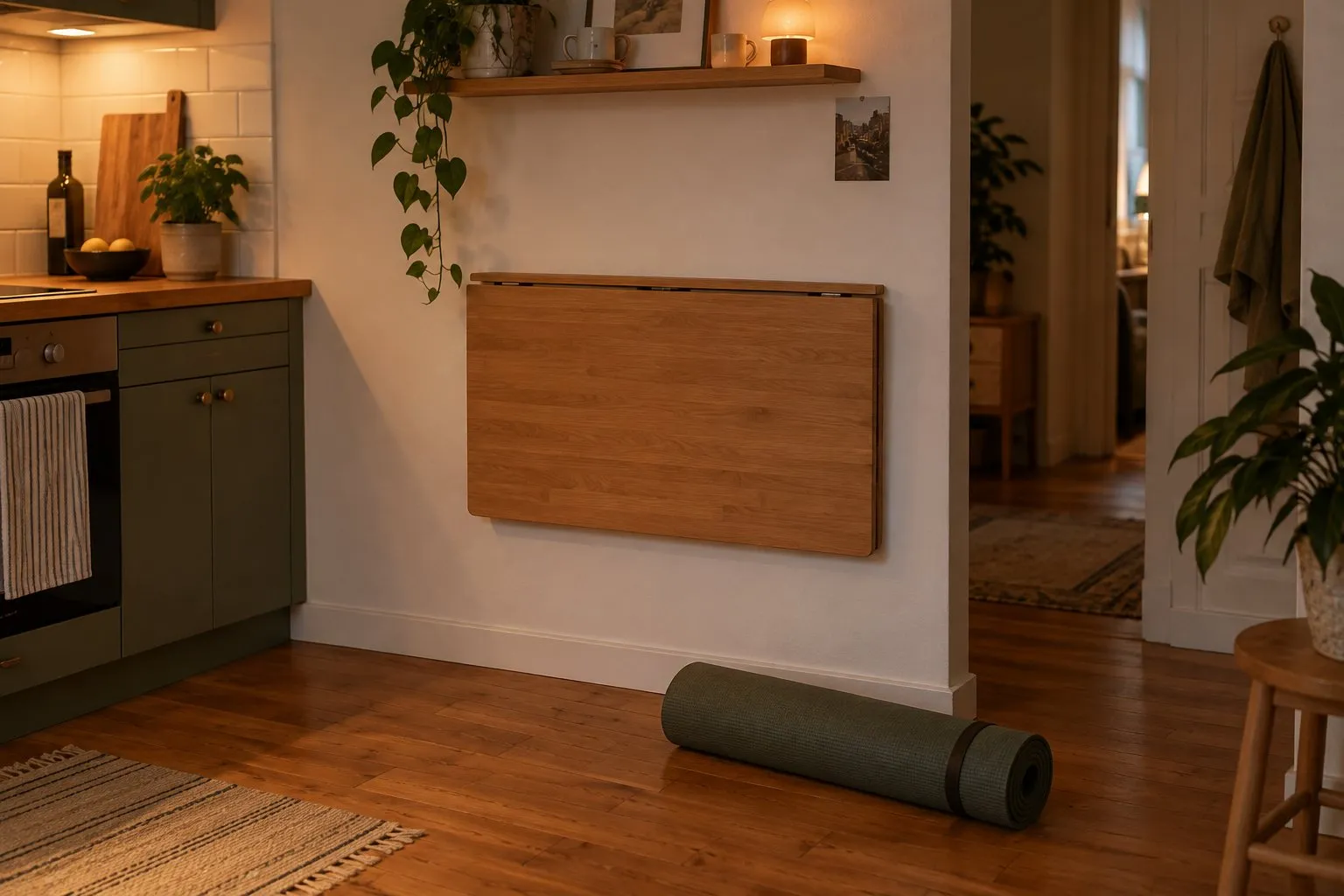
A Murphy table takes its name from the Murphy bed, which William Lawrence Murphy patented in the early 20th century: a bed hinged at one end that stores vertically against the wall. The table version works the same way. A shallow cabinet hangs on the wall; its top is hinged at the cabinet's lower edge and swings down to a horizontal dining surface; a leg folds out from the underside to carry the front edge. Closed, the top stands upright inside the cabinet and the wall looks like a flat panel or a picture frame. What a Murphy table is, and what Amazon sells under the name, is explained in the Murphy table guide.
The job suits someone who already builds furniture: you need to cut panels square, set hinges in line and drive screws into studs. If you would rather buy, a ready-made drop-leaf table does the same job with maker data – see the end of this page.
Tools and material
- Stud finder, tape measure, level, pencil, drill and driver
- Panels for the cabinet box and a solid board as mounting rail across the back
- A top: plywood, hardwood or a sealed panel
- One continuous piano hinge or several strong butt hinges for the top
- Locking folding-leg hinges, for example the TopDirect locking hinge, 4 pack*
- A leg (or two) of solid wood
- A latch or catch that holds the closed top
- Screws long enough to reach well into the studs through the mounting rail
Step by step
Find the studs and plan the width
Locate the studs and mark their centers. Wood studs are 16 or 24 inches on center, depending on stud size and load (IRC Table R602.3(5)) – measure, do not assume. Plan the cabinet width so its mounting rail crosses at least two studs. The width of the top follows from the cabinet: the top has to fit inside it when closed.Fix the table height
Decide where the open top surface should sit. For meals and seated work, about 29 to 30 inches is usual, and the 2010 ADA Standards set 28 to 34 inches for dining surfaces. The hinge line on the cabinet's lower edge sets that height together with the top thickness, so draw the open position on paper or on the wall before you build. The mounting height guide shows how to work from the top edge down.Size the cabinet depth
Lay the top on a bench, fold the leg flat against its underside with the leg hinges mounted, and measure the total thickness of the stack, including the knuckles of the top hinge. Add clearance so nothing rubs when you close it. That is the inside depth of the cabinet. There is no standard figure – it follows from your parts.Build and mount the cabinet
Build a box from your panels with a solid mounting rail across the back. Hold it level on the wall and screw the rail into every stud it crosses. The cabinet carries the top and part of every load on it, so do not hang it on hollow-wall anchors: TOGGLER's technical sheet notes that industry standards recommend only one quarter of an anchor's ultimate test load as working load. The CPSC's Anchor It! campaign says anchoring furniture with drawers, doors and shelves to the wall prevents tip-over injuries – a Murphy table cabinet is that kind of furniture. If a stud is missing where you need it, see the installation guide for a ledger board across the studs.Hinge the top to the cabinet
Fix the top to the lower edge of the cabinet with a continuous piano hinge or several strong butt hinges in line. Swing it down: the top should come to rest horizontal without binding against the cabinet sides. The guide to fold-down table hinges compares hinge types and what their listings state.Fit the fold-down leg
Screw locking folding-leg hinges to the underside of the top near the front edge and fix the leg to them. Cut the leg so the open top sits level on your floor. Place it so knees have room: the ADA Standards treat the space between 9 and 27 inches above the floor as knee clearance and ask for at least 30 inches of width. Check that the hinges lock before you put weight on the top.Add a latch and check the fold
Fit a latch or catch that holds the closed top inside the cabinet, so it cannot swing down on its own. Then open and close the table several times, check that the leg locks every time and that the top is level, and only then put plates on it.
Typical mistakes
- Building the cabinet first and measuring the stack later. The folded leg and hinges often need more depth than expected.
- Mounting between studs. On drywall alone, the cabinet hangs on anchors that carry only a fraction of their headline figure; screw the rail into studs.
- No latch. A closed top that can swing open by itself is a hazard.
- A leg that does not lock. An unlocked leg folds under load and drops the top.
- Trusting a hinge listing figure. Seller figures for hinges or brackets are not a rating for your table.
Safety
A falling top can injure. If you are unsure about your wall, the screws or the hinge sizes, ask a carpenter. Walls can hide cables and pipes – check before you drill. If you rent, ask your landlord for written permission first.
Rather buy than build?
COSTWAY Drop-Leaf 31.5 x 23.5
A drop-leaf top deep enough for two place settings that folds to 3 inches against the wall.
Why here: A ready-made alternative for two people: a drop-leaf top 23.5 inches deep that folds to 3.0 inches, with a 66 lb maximum stated by Costway.
Best for: Small kitchens and studios where two people eat or work at the wall
- 23.5 in deep when open – room for two plates facing each other
- Folded size 31.5 x 21 x 3.0 in according to Costway
- Two ways to fold: drop one leaf or both
- Maker states a 66 lb maximum load
- Costway does not say which wall or fasteners the 66 lb rating assumes
- The supplied expansion screws are generic – plan your own fasteners for studs or masonry
- MDF top: wipe spills, do not leave it wet
- Type
- Drop-leaf top on a wooden support
- Top size
- 31.5 x 23.5 in (open)
- Folded depth
- 3.0 in (Costway)
- Load rating
- 66 lb max (Costway)
- Mounting
- Hinges and screws; studs not mentioned
- Material
- P2 MDF, pine, metal hinges
The COSTWAY drop-leaf table has no cabinet, but it gives a dining spot for two that folds flat, with size and load on the maker's page. Costway does not name a wall for its 66 lb, so screw it into studs or a ledger. If you would rather build a simpler table without a cabinet, the guide to a DIY wall-mounted folding table uses folding brackets, and the comparison brackets or a ready-made table helps you decide.
Questions people ask
How do you build a Murphy table?
Build a shallow wall cabinet, screw it into at least two wall studs, and hinge the table top to the cabinet's lower edge so it folds down to table height. A fold-down leg with locking hinges carries the front edge, and a latch holds the top inside the cabinet when it is closed. Plan the height and the cabinet depth before cutting anything.
How deep does a Murphy table cabinet need to be?
Deep enough to hold the folded top, the leg folded flat against its underside and the hinge knuckles, with a little clearance so nothing rubs. Lay the top, leg and hinges together on a bench, measure the stack and add clearance. There is no standard depth; it follows from your parts.
Are there free Murphy table plans?
Many woodworking sites and videos publish plans. Check any plan for three things before you build: how the cabinet is fixed into studs, how the leg locks, and what keeps the closed top from falling open. Plans rarely give a load rating, and none can know your wall.
What hinges do I need for a Murphy table?
Two kinds: a hinge between the cabinet and the top, such as a continuous piano hinge or several strong butt hinges along the lower edge, and locking folding-leg hinges for the leg. The TopDirect locking hinge, for example, locks at 90 degrees according to its seller. The hinge guide compares the types.
Sources
- Wikipedia: Murphy bed (origin of the name, William Lawrence Murphy)
- 2012 Seattle Residential Code, Chapter 6 (IRC text), Table R602.3(5) Size, height and spacing of wood studs
- U.S. Access Board: 2010 ADA Standards, 902.3 dining surface height and 306.3 knee clearance
- TOGGLER: SNAPTOGGLE technical data sheet (ultimate loads, 1/4 working-load note)
- U.S. CPSC: Anchor It! campaign (anchoring furniture with doors and shelves)
Keep reading
- Buying guideMurphy tablesWhat a Murphy table is, why most Amazon listings with the name are desks, and which wall-mounted fold-down table to buy for a kitchen or dining nook instead.
- Buying guideFold-down table hingesHinges for a fold-down table or desk: locking folding brackets, drop-leaf hinges with leaf supports, flap stays for desks and locking leg hinges, with maker data.
- How-toHow to installInstall a wall-mounted folding table safely: find the studs, mark the top edge, drill per the manual and use a ledger board when the brackets miss a stud.
- How-toDIY folding tableBuild a DIY wall-mounted folding table on folding shelf brackets: plan the top around your studs, pick the bracket length, cut the top and mount it safely.
- ComparisonBrackets or ready-madeDIY top on folding shelf brackets or a ready-made fold-down table? Load data, stud spacing, size and effort compared, with a clear rule for when each one wins.
Who writes here
wallmountedfoldingtable.com Editorial Team
Fold-down tables, desks & workbenches
We are the editorial team at wallmountedfoldingtable.com. We compare maker spec sheets, manuals, retailer data, building codes and anchor data for wall-mounted folding tables and turn them into plain-English advice – with sources on every page. We do not run lab tests or load tests, and we say so openly.
- Maker specs, manuals & codes compared
- Sources on every page
- No lab tests – stated openly
- Publisher details in the imprint