Comparison
Folding Brackets and a Board or a Ready-Made Folding Table?
Buy a ready-made fold-down table when one in a size you can use exists: you get a load figure, named wall types and drilling instructions from the maker. Build your own on folding shelf brackets only when you need a top deeper, longer or tougher than the ready-made ones – and accept that nobody gives a load figure for your build.
Disclosure: This page contains affiliate links (marked with *). If you buy through them, we earn a small commission at no extra cost to you. As an Amazon Associate I earn from qualifying purchases. Learn more
The short version
A ready-made table such as the VIVO 43 x 18 workbench comes with maker data: 110 lb on wood stud, brick or concrete, 2.3 inches folded, and a manual that says how many screws go into each stud. A DIY top on 24-inch brackets can be deeper and longer, but bracket listings print figures like 440 lb without saying per bracket, per pair or for which wall.
Short verdict
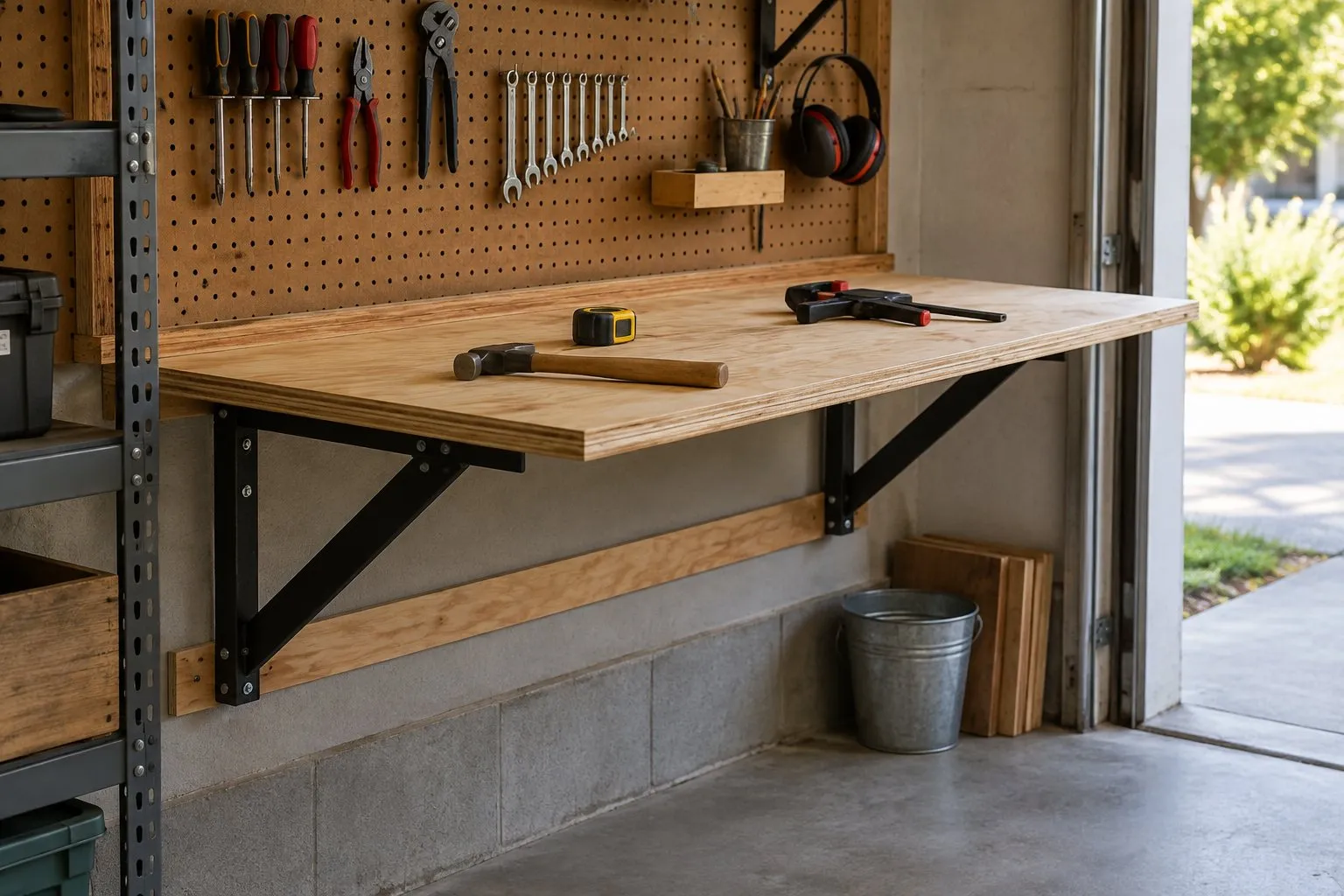
Both options work the same way: a top on two hinged steel arms, screwed to the wall. The difference is who stands behind the numbers. A ready-made table comes with a maker's load figure, the walls it assumes and drilling instructions. A bracket build gives you any size and material you like, but the only load figure is the bracket seller's, and it describes the steel, not your table.
Take the ready-made table if a top of about 43 x 18 inches (or a smaller kitchen size) covers your job. Build with brackets if you need a top deeper than about 18 inches, longer than about 4 feet, or made of a material the ready-made tables do not offer, such as a thick butcher block or a hardwood bench top. The guide to folding shelf brackets lists the brackets by length.
VIVO 43 x 18 Workbench
A 43-inch workbench top on steel brackets that folds to 2.3 inches from the wall.
Why here: The ready-made option with the clearest maker data: 110 lb on wood stud, brick or concrete, 2.3 inches folded and a manual that says exactly which bracket holes go into a stud.
Best for: Garages and basements with wood studs, brick or concrete walls
- VIVO names the wall types: wood stud, brick or concrete
- 110 lb capacity stated by the maker
- Folds to 2.3 in from the wall
- 3-year warranty (VIVO)
- Particle board top – not for wet work or heavy pounding
- Type
- Top on folding steel brackets
- Top size
- 43.3 x 18 x 1 in
- Load rating
- 110 lb (VIVO)
- Mounting
- Wood stud, brick or concrete (VIVO)
- Folded depth
- 2.3 in (VIVO)
- Warranty
- 3 years (VIVO)
The two options side by side
| Point | Ready-made (VIVO 43 x 18) | DIY on brackets (CLT 24 in pair) |
|---|---|---|
| Top | 43.3 x 18 x 1 in particle board, included | your choice, bought separately |
| Arm length | 15.4 in (VIVO) | about 23.6 in (listing) |
| Load figure | 110 lb (VIVO) | 440 lb max, per bracket or pair not stated (listing) |
| Walls named | wood stud, brick, concrete (VIVO) | “on the studs” (listing) |
| Folded depth | 2.3 in (VIVO) | depends on your top |
| Drilling instructions | yes, per wall type (manual) | none in our data |
| Warranty | 3 years (VIVO) | not stated in our data |
| Effort | mount brackets, attach top | cut and finish a top, plan spacing, mount |
| Comparison | Our garage pickVIVO 43 x 18 Workbench | Seller data onlyCLT 24 in Brackets | Seller data only16 in Stainless Brackets |
|---|---|---|---|
| Type | Top on folding steel brackets | Folding shelf brackets, 2 pcs | Folding shelf brackets, 2 pcs |
| Top size | 43.3 x 18 x 1 in | 24 in (listing) | 16 in (listing) |
| Load rating (as stated) | 110 lb (VIVO) | 440 lb max (listing) | – |
| Mounting (as stated) | Wood stud, brick or concrete (VIVO) | On studs (listing) | – |
| Folded depth | 2.3 in (VIVO) | – | – |
| Best for | Garages and basements with wood studs, brick or concrete walls | Building your own 20 to 24 in deep fold-down table or workbench | 16 to 18 in deep tops: laundry, desk or breakfast ledge |
| On Amazon(paid link to Amazon, opens in a new tab)Ad · paid link · check price & delivery on Amazon | On Amazon(paid link to Amazon, opens in a new tab)Ad · paid link · check price & delivery on Amazon | On Amazon(paid link to Amazon, opens in a new tab)Ad · paid link · check price & delivery on Amazon |
The differences point by point
Load figures: one is a rating, the other a headline
VIVO states 110 lb for the complete bench and names the walls: wood stud, brick or concrete. Its manual adds the warning not to exceed that figure and not to install into drywall alone. The CLT pair prints “max. load 440 lb” and tells buyers to mount the brackets straight on the studs, but it does not say whether 440 lb is per bracket or per pair, and it cannot know your top, your screws or your wall. Do not read the larger number as the stronger table. How a rating relates to the wall behind it is explained under weight capacity.
Size: where brackets win
The ready-made tops in our comparison stop at about 18 inches deep for benches and 23.5 inches for the COSTWAY dining table. With 24-inch brackets you can carry a top of about 20 to 24 inches and make it as long as your studs allow – with two more brackets in the middle if the top gets long. The rule of thumb for arm length is in the question which bracket length you need. Remember that a deeper top is also a longer lever: the further out the load sits, the harder the upper screws are pulled out of the wall.
Stud spacing: both can be planned, but differently
Wood studs are 16 or 24 inches on center, depending on stud size and load (IRC Table R602.3(5)). The VIVO manual allows a bracket spacing from 400 to 800 mm (about 15.7 to 31.5 inches) under the top, so the brackets can sit at 16 or 24 inches to match either wall. Each bracket then takes three screws in a vertical row into the center of a stud. Mount-It! describes the same idea for its long top: the arms go under the top at the distance between two stud centers. With loose brackets you are free to choose any spacing, but you also have to work it out yourself, including where the top overhangs.
Stud span check
Enter the width of the top and the stud spacing of your wall.
Depending on where you place it, the top spans 2 to 3 studs.
Pure geometry from the stud spacing. Find the actual studs in your wall with a stud finder before drilling.
Effort and the parts you still need
A ready-made table needs a stud finder, a drill, a level and the screws in the box (for masonry, VIVO supplies anchors and specifies a 5/16-inch bit, 3 inches deep). A bracket build adds a top that has to be cut, sanded and sealed, the right screws to join top and arms, and fasteners matched to your wall. If you want a leg under the front edge as well, see the guide to fold-down table hinges. Plans with cutting steps are in the guides to a DIY wall-mounted folding table and a DIY folding workbench.
The weak point is the same for both
Whatever you choose, the fixing in the wall usually limits the load before the steel does. On drywall without a stud, hollow-wall anchors carry only a fraction of their headline figure: TOGGLER's sheet notes that industry standards recommend one quarter of the ultimate test load as working load. If a bracket misses a stud, a ledger board across at least two studs is the fix, as the installation guide shows.
Take the ready-made table if …
- an 18-inch-deep bench or a dining top of up to 23.5 inches is enough,
- you want a load figure, named walls and drilling steps from the maker,
- you would rather not cut and finish a top yourself.
For heavy garage work with legs under the front edge, the Lifetime 80421 work table* is the premium alternative; the garage workbench guide compares the benches.
Build with brackets if …
- you need a top deeper than about 18 inches or longer than about 4 feet,
- you want a specific material, such as a thick hardwood top,
- you can plan the bracket spacing onto your studs and accept that no load rating exists for the finished build.
Every ready-made table with its rating and stated mounting is in the comparison of wall-mounted folding tables.
Questions people ask
Is a wall-mounted folding workbench strong enough, or should I build one with heavy-duty folding brackets?
A ready-made bench is strong enough for the load its maker states on the wall it names – VIVO gives 110 lb on wood stud, brick or concrete for its 43 x 18 bench. Building your own gets you a bigger top, but no tested rating: bracket listings print large figures without a wall or a per-bracket statement. In both cases the studs or masonry anchors usually set the real limit.
Are folding brackets stronger than a ready-made folding table?
The printed numbers suggest so – 440 lb on a pair of CLT 24-inch brackets against 110 lb for the VIVO bench – but they are not comparable. VIVO's figure belongs to a complete table on named walls. The bracket figure says neither per bracket or per pair nor which wall, top or screws it assumes, so it tells you nothing about the finished DIY table.
Is it cheaper to build a fold-down table with brackets?
Not automatically. A pair of folding brackets alone is often in the budget class, but you still need a top, edge finish and fasteners matched to your wall. The VIVO bench is itself a budget-class product with the top included. Building pays off when you need a size or material that no ready-made table offers.
Sources
- VIVO: Wall Mounted 43 x 18 inch Folding Workbench, MOUNT-SF1FB (maker page)
- VIVO: MOUNT-SF1FB instruction manual (PDF, bracket spacing 400–800 mm, stud and masonry options)
- Mount-It!: MI-7993 installation manual (PDF, bracket spacing equal to stud spacing)
- 2012 Seattle Residential Code, Chapter 6 (IRC text), Table R602.3(5) Size, height and spacing of wood studs
- TOGGLER: SNAPTOGGLE technical data sheet (ultimate loads, 1/4 working-load note)
Keep reading
- Buying guideFolding bracketsFolding shelf brackets for a DIY fold-down table or workbench: which arm length fits your top, how to read load ratings, and how to land every bracket on a stud.
- Buying guideGarage workbenchWall-mounted folding workbenches for the garage compared: VIVO, Lifetime and long benches by size, stated load rating, wall type and stud spacing.
- ComparisonAll tables comparedThe best wall-mounted folding tables, desks and workbenches side by side: top size, load rating with the mounting it assumes, folded depth and maker sources.
- Question & answerWhat Bracket Length Does a 24-Inch-Deep Fold-Down Table Need?Which folding bracket length suits a 24-inch-deep fold-down top, why the arm must not reach past the front edge, and what a shorter arm changes for the top.
- How-toDIY folding tableBuild a DIY wall-mounted folding table on folding shelf brackets: plan the top around your studs, pick the bracket length, cut the top and mount it safely.
Who writes here
wallmountedfoldingtable.com Editorial Team
Fold-down tables, desks & workbenches
We are the editorial team at wallmountedfoldingtable.com. We compare maker spec sheets, manuals, retailer data, building codes and anchor data for wall-mounted folding tables and turn them into plain-English advice – with sources on every page. We do not run lab tests or load tests, and we say so openly.
- Maker specs, manuals & codes compared
- Sources on every page
- No lab tests – stated openly
- Publisher details in the imprint