Question & answer
What Bracket Length Does a 24-Inch-Deep Fold-Down Table Need?
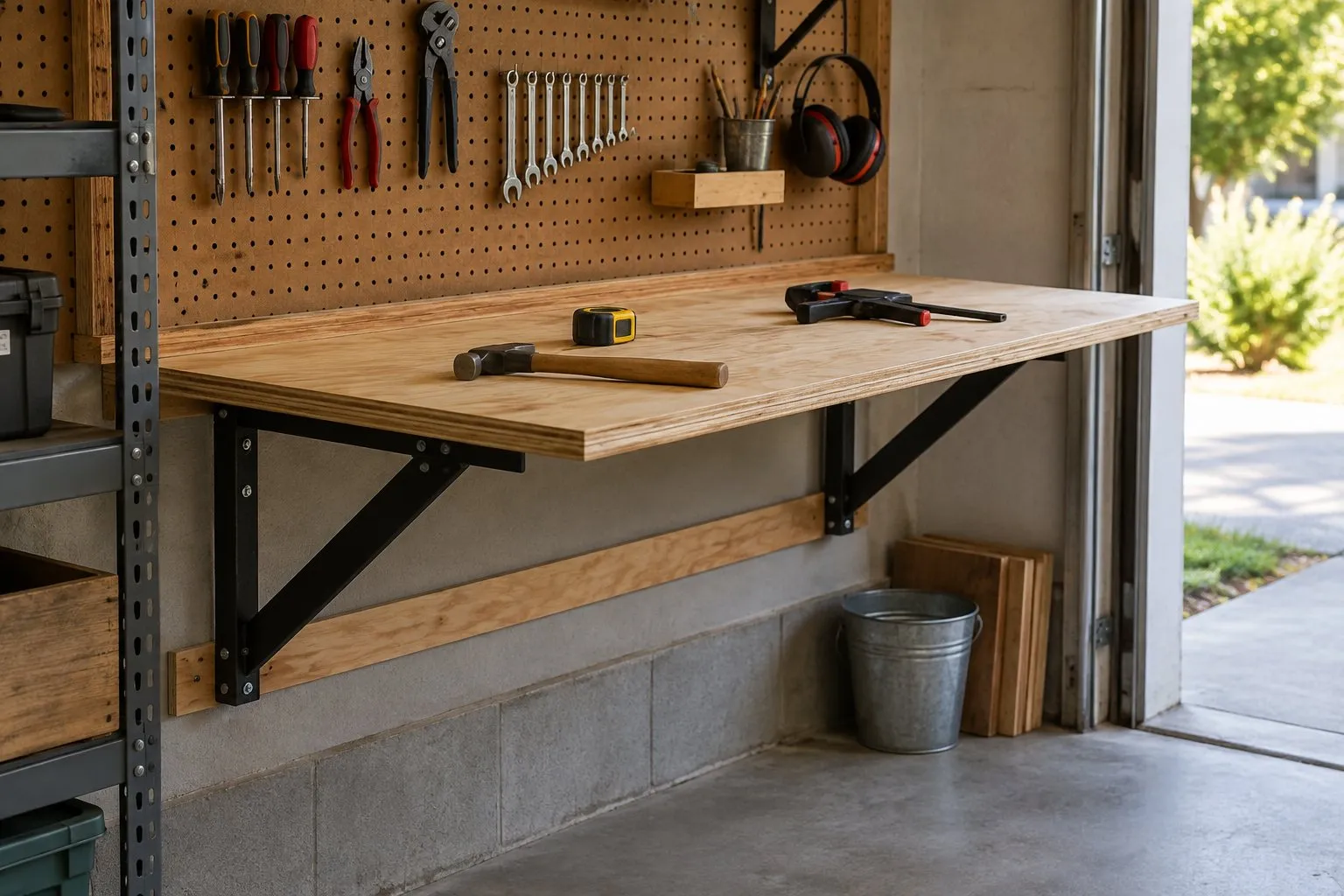
For a 24-inch-deep fold-down top, use folding brackets with arms of about 20 to 24 inches. There is no published standard for this; it is a rule of thumb. The arm should end just behind the front edge – Mount-It! warns that its brackets must not reach past it – and the shorter the arm, the more of the top hangs out unsupported.
Disclosure: This page contains affiliate links (marked with *). If you buy through them, we earn a small commission at no extra cost to you. As an Amazon Associate I earn from qualifying purchases. Learn more
The short answer
Use 24-inch folding brackets for a 24-inch-deep top, or about 20 inches at the least. That is a rule of thumb, not a standard: VIVO, for example, puts 15.4-inch brackets under an 18-inch-deep top, about 2.6 inches short of the edge. The arm must not stick out past the front edge, and every bracket still needs its screws in a stud.
The short rule and where it comes from
We found no building code, standard or maker guide that ties bracket length to top depth. What exists are the makers' own combinations. The clearest one we could read: VIVO's 43 x 18 inch folding workbench sits on brackets 15.4 inches long under a top 18 inches deep. The arm ends about 2.6 inches behind the front edge and covers about 85 percent of the depth.
Scaled to a 24-inch top, the same proportion gives an arm of about 20 inches. A 24-inch arm supports the top almost to its edge. That is why the rule of thumb reads “20 to 24 inches”. Folding brackets on Amazon are sold in steps of 10, 12, 16 and 24 inches in our data, so for a 24-inch-deep top the practical choice is a 24-inch pair.
Why the arm must stay behind the front edge
Mount-It!'s manual for its MI-7993 table tells you to position the brackets at the rear of the top and make sure their front does not extend out over the front edge. An arm that sticks out is a knee and hip hazard and catches anything that slides off the table. So a 24-inch arm suits a top that is 24 inches deep or a little deeper. Measure the open bracket from the wall plate to the tip, not the length printed on the box, and leave room for the gap between top and wall: VIVO asks for at least 3/8 inch so that its top can fold.
What a shorter arm changes
| Arm under a 24 in top | Unsupported front strip | What it means |
|---|---|---|
| 24 in | close to 0 in | the top rests on the arms almost to the edge |
| 20 in | about 4 in | similar to the proportion VIVO uses |
| 16 in | about 8 in | a third of the depth hangs out |
| 12 in | about 12 in | half the depth hangs out; a shelf bracket, not a table bracket |
The overhang is a cantilever: the top has to carry the front strip by its own stiffness, and a load on the edge bends it over the bracket tips. A thin or soft top sags first.
What the arm length does not change is the pull on the wall. Whatever sits on the top pushes down at some distance from the wall, and the brackets turn that into a pull on their upper screws. The deeper the top and the further out the load, the harder those screws are pulled. A 24-inch-deep top therefore needs its screws in studs or a ledger board regardless of the arm – see how much weight a wall-mounted folding table holds.
Check the fold before you buy
A folding bracket table hangs down when it is folded, so a 24-inch-deep top drops roughly 24 inches below its hinge line. With the top edge at about 29 to 30 inches for meals, the folded top reaches down to about 5 or 6 inches above the floor. A baseboard heater, an outlet or a trash can under the table can block it. The page on mounting height shows how to work out the bracket line from the top edge.
Spacing matters as much as length
Two 24-inch brackets only help if each one is screwed into a stud. Wood studs are 16 or 24 inches on center (IRC Table R602.3(5)), so plan the bracket spacing on your wall first and the width of the top second. The question are studs 16 or 24 inches apart explains how to check your wall.
A 24-inch pair from our data
CLT 24 in Brackets
A pair of 24-inch stainless folding brackets for a deep DIY top.
Seller data only: We only have the Amazon listing for this product. We list it as an option, not as a recommendation.
Why here: The only 24-inch pair in our data whose listing tells buyers to mount the brackets on studs; its 440 lb figure does not say per bracket or per pair.
Best for: Building your own 20 to 24 in deep fold-down table or workbench
- 24 in arms for a deep top (listing)
- Brushed stainless steel (listing)
- The listing tells buyers to mount them on studs
- “Max. load 440 lb” without saying per bracket or per pair
- Only seller data (Amazon listing)
- Type
- Folding shelf brackets, 2 pcs
- Bracket length
- 24 in (listing)
- Load rating
- 440 lb max (listing)
- Mounting
- On studs (listing)
- Material
- Stainless steel (listing)
The Wallmaster 24-inch brackets* and the plain 24-inch steel pair* are further options with seller data only. All bracket lengths side by side, with their printed load figures, are on the page about folding shelf brackets. More questions are answered under questions and answers.
Questions people ask
Can I use 16-inch brackets under a 24-inch-deep top?
It is not what we would plan. With 16-inch arms, 8 inches of the top hang out in front of the brackets, a third of its depth. The top then has to carry that front strip on its own, and anyone leaning on the edge bends it over the bracket tips. The bracket listings in our data give no rule for how much overhang their figures allow.
Do longer brackets let the table hold more weight?
Not in a way any listing documents. The pull on the wall screws comes from how far out the load sits, and that is set by the depth of the top, not by the arm. A longer arm supports the top closer to its front edge, so the top bends less. The load figures in bracket listings name no wall and no top depth.
Sources
- VIVO: Wall Mounted 43 x 18 inch Folding Workbench, MOUNT-SF1FB (maker page, bracket and top dimensions)
- Mount-It!: MI-7993 user manual (PDF, bracket position under the top)
- VIVO: MOUNT-SF1FB instruction manual (PDF, gap to the wall)
- 2012 Seattle Residential Code, Chapter 6 (IRC text), Table R602.3(5) Size, height and spacing of wood studs
Keep reading
- Buying guideFolding bracketsFolding shelf brackets for a DIY fold-down table or workbench: which arm length fits your top, how to read load ratings, and how to land every bracket on a stud.
- Question & answerAre Studs 16 or 24 Inches Apart, and How Does That Limit Where Your Table Can Go?Wood studs can be 16 or 24 inches on center. What the residential code table says, how to measure your wall and when a fold-down table needs a ledger board.
- ExplainerWeight capacityHow much weight a wall-mounted folding table can hold: maker load ratings from 33 to 150 lb, what the wall and anchors add, and why leverage limits the load.
- ExplainerMounting heightWall-mounted folding table height: 28 to 34 inches for dining and desks per ADA 902.3, IKEA's bar heights, and why laundry height has no official number.
- OverviewQuestions & answersShort, sourced answers to the questions people ask before and after buying a wall-mounted folding table: walls, studs, brackets, rentals, load and height.
Who writes here
wallmountedfoldingtable.com Editorial Team
Fold-down tables, desks & workbenches
We are the editorial team at wallmountedfoldingtable.com. We compare maker spec sheets, manuals, retailer data, building codes and anchor data for wall-mounted folding tables and turn them into plain-English advice – with sources on every page. We do not run lab tests or load tests, and we say so openly.
- Maker specs, manuals & codes compared
- Sources on every page
- No lab tests – stated openly
- Publisher details in the imprint