Question & answer
Can a Fold-Down Table Go on a Plaster-and-Lath Wall?
Yes – a fold-down table can go on a plaster-and-lath wall, but only into the studs behind it. The lath is a set of thin wood strips nailed to the studs, and the plaster hangs on it by its “keys”; neither is meant to carry a table. Screw the brackets, or a ledger board, through plaster and lath into the stud centers.
Disclosure: This page contains affiliate links (marked with *). If you buy through them, we earn a small commission at no extra cost to you. As an Amazon Associate I earn from qualifying purchases. Learn more
The short answer
Yes, if the bracket screws go into the studs behind the plaster. Wood lath is nailed to the studs, and the plaster is held by keys pushed through the lath (National Park Service). On wood lath the plaster alone is about 3/4 to 7/8 inch thick, so the screws must be long enough to pass it and still bite into the stud. Hollow-wall anchors and loose plaster are no base for a table.
How a plaster-and-lath wall is built
The National Park Service describes the traditional build-up in its Preservation Brief 21. Wooden lath – narrow, thin strips with gaps between them – was nailed at right angles directly to the studs or to furring strips. The plasterer pushed wet plaster through the gaps, where it slumped behind the lath and formed “keys”, and these keys hold the plaster in place. The best work had three coats: a scratch coat and a brown coat of about 3/8 inch each and a finish coat of about 1/8 inch. The brief gives the minimum total thickness on wood lath as about 3/4 to 7/8 inch, on metal lath 5/8 inch and on rock lath (gypsum board lath) 1/2 inch.
Two things follow for a fold-down table:
- Only the studs carry load. The lath is thin and the plaster is held by its keys. A table bracket screwed into lath or plaster alone is screwed into the finish, not into the structure.
- The finish is thicker than drywall. Your screws first have to pass the plaster and the lath before they reach the stud. Choose screws long enough to reach well into the stud after that layer, in line with what the table maker asks for.
Why old plaster can be a weak base
The same brief explains how plaster fails: structural movement, rotting lath, rusted nails or poor-quality plaster can break the keys, and once the bond with the lath is broken, plaster becomes loose or bowed. The brief also shows hairline, stress and settlement cracks in old walls. Before you mount anything, press on the wall where the table will go. If the plaster moves or sounds hollow over a larger area, have it repaired first; Preservation Brief 21 describes re-attaching loose plaster with screws and plaster washers, which is a repair, not a table mount.
Studs behind plaster: find them, do not assume them
Today's residential code allows wood studs 16 or 24 inches on center, depending on stud size and load (IRC Table R602.3(5)). Older houses may differ: the Park Service notes that builders of now-historic houses had no codes to size their framing members. Mark each stud you find, confirm it with a small test hole where the bracket will later cover it, and measure the spacing on your wall. The question are studs 16 or 24 inches apart explains why the spacing decides where brackets can go.
The mounting that works
- Brackets straight into stud centers, if their spacing matches your studs.
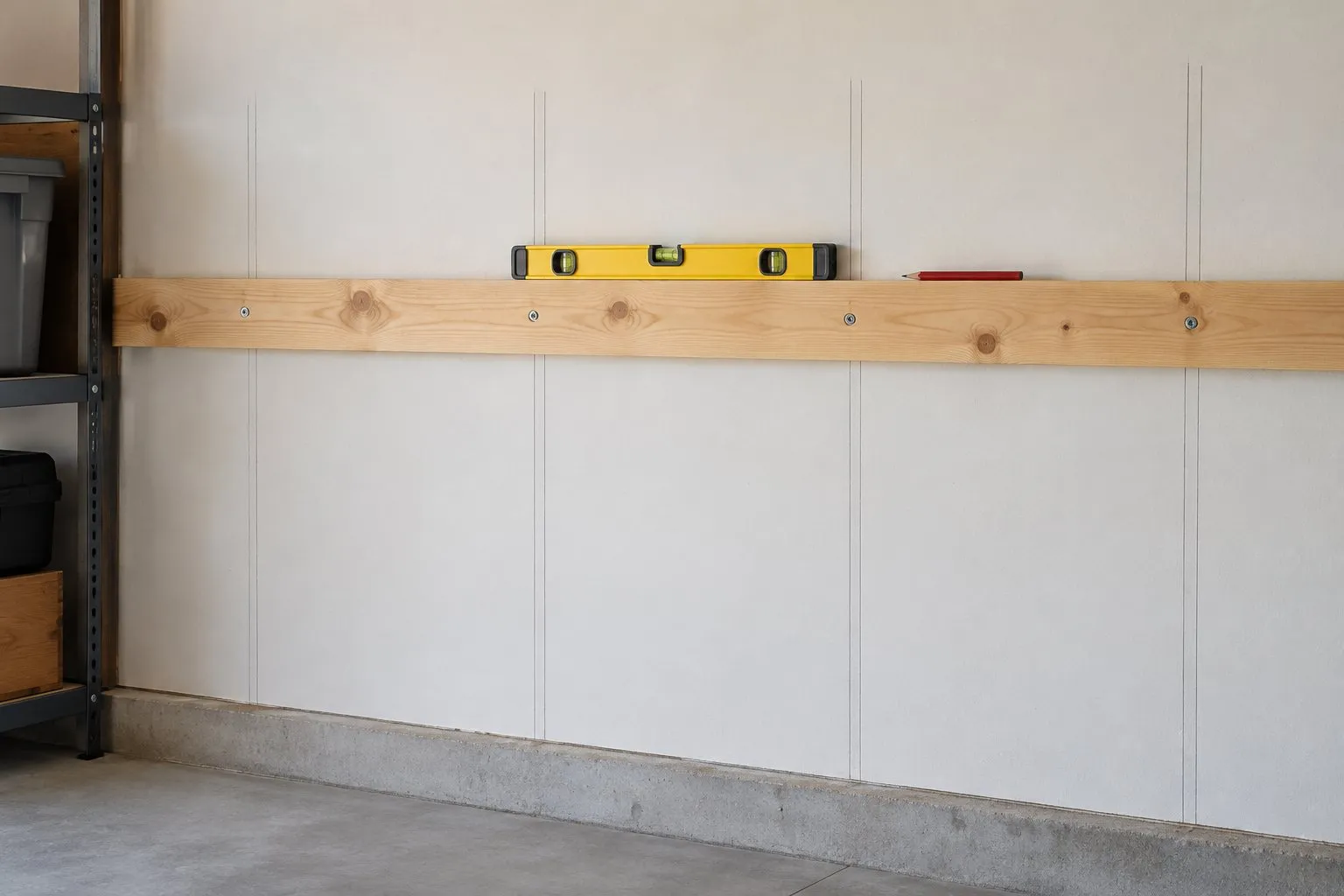
- A ledger board screwed through plaster and lath into at least two studs, with the brackets mounted on the board. This is the usual fix when the brackets and studs do not line up; the steps are in the guide on how to install a wall-mounted folding table.
- Not hollow-wall anchors. TOGGLER lists drywall, plasterboard, concrete block, plywood and tile over drywall as surfaces for its SnapToggle – plaster on wood lath is not on that list. Why anchors alone are a poor base for a table is explained under drywall without studs.
If the plaster sits on brick or block instead of a stud wall, the fixing goes into the masonry; see mounting on concrete or cinder block.
A table whose maker names the wall
VIVO 43 x 18 Workbench
A 43-inch workbench top on steel brackets that folds to 2.3 inches from the wall.
Why here: VIVO names its mounting options – wood stud, brick or concrete – so on a plaster wall you know the screws belong in the studs.
Best for: Garages and basements with wood studs, brick or concrete walls
- VIVO names the wall types: wood stud, brick or concrete
- 110 lb capacity stated by the maker
- Folds to 2.3 in from the wall
- 3-year warranty (VIVO)
- Particle board top – not for wet work or heavy pounding
- Type
- Top on folding steel brackets
- Top size
- 43.3 x 18 x 1 in
- Load rating
- 110 lb (VIVO)
- Mounting
- Wood stud, brick or concrete (VIVO)
- Folded depth
- 2.3 in (VIVO)
- Warranty
- 3 years (VIVO)
More short answers are collected under questions and answers; all tables with their stated mounting are on the homepage.
Questions people ask
Can I use toggle bolts in plaster and lath?
We would not rely on them for a table. TOGGLER lists drywall, plasterboard, concrete block, plywood and tile over drywall as surfaces for its SnapToggle, not plaster on wood lath. Old plaster may also have lost its keys and come loose from the lath. For a fold-down table, go into the studs or onto a ledger board fixed to the studs.
Are studs behind plaster walls 16 inches apart?
Do not assume it. Today's code allows 16 or 24 inches on center depending on stud size and load, and the National Park Service notes that builders of now-historic houses had no codes to size their framing. Locate each stud and check the spacing on your own wall before you plan the bracket positions.
Should I worry about lead paint when drilling an old plaster wall?
If the house was built before 1978, it is more likely to have lead-based paint, according to the EPA, and work that disturbs painted surfaces can create lead dust. Drilling a few holes is a small job, but follow the EPA's advice on keeping dust down and cleaning up, or hire a contractor for the job.
Sources
- National Park Service: Preservation Brief 21, Repairing Historic Flat Plaster – Walls and Ceilings (PDF)
- TOGGLER: SNAPTOGGLE heavy-duty toggle bolt, carbon steel (compatible surfaces)
- 2012 Seattle Residential Code, Chapter 6 (IRC text), Table R602.3(5) Size, height and spacing of wood studs
- U.S. EPA: Protect Your Family from Sources of Lead
- VIVO: Wall Mounted 43 x 18 inch Folding Workbench, MOUNT-SF1FB (maker page, mounting options)
Keep reading
- How-toHow to installInstall a wall-mounted folding table safely: find the studs, mark the top edge, drill per the manual and use a ledger board when the brackets miss a stud.
- Question & answerCan You Mount a Fold-Down Table on Drywall Without Studs?Can a fold-down wall table hang on drywall without studs? Why hollow-wall anchors are the weak point, and how a ledger board across the studs solves it.
- Question & answerAre Studs 16 or 24 Inches Apart, and How Does That Limit Where Your Table Can Go?Wood studs can be 16 or 24 inches on center. What the residential code table says, how to measure your wall and when a fold-down table needs a ledger board.
- Question & answerHow Do I Mount a Folding Table on Concrete or Cinder Block?Mounting a fold-down table on concrete or cinder block: which anchors, why hollow block holds far less than solid concrete, and why mortar joints are off limits.
- OverviewQuestions & answersShort, sourced answers to the questions people ask before and after buying a wall-mounted folding table: walls, studs, brackets, rentals, load and height.
Who writes here
wallmountedfoldingtable.com Editorial Team
Fold-down tables, desks & workbenches
We are the editorial team at wallmountedfoldingtable.com. We compare maker spec sheets, manuals, retailer data, building codes and anchor data for wall-mounted folding tables and turn them into plain-English advice – with sources on every page. We do not run lab tests or load tests, and we say so openly.
- Maker specs, manuals & codes compared
- Sources on every page
- No lab tests – stated openly
- Publisher details in the imprint