Troubleshooting
Fold-Down Table Sags, Wobbles or Won't Lock: Causes and Fixes
A fold-down table that sags or wobbles is usually loose at the wall: screws that have worked loose, a bracket that sits in drywall instead of a stud, or a latch that has not fully engaged. Unload the table first, then check the latches, the screws and the wall behind them, in that order. A top that pulls away from the wall at the upper edge needs fixing before anyone uses it again.
Disclosure: This page contains affiliate links (marked with *). If you buy through them, we earn a small commission at no extra cost to you. As an Amazon Associate I earn from qualifying purchases. Learn more
The short version
Take everything off and check three things: do both latches lock fully when the top is raised, are all screws tight, and does every bracket sit in a stud, a ledger board on studs or solid masonry? Re-tighten loose screws, as IKEA advises for its wall tables. If the upper screws pull out of drywall, remount on studs or a ledger board. Never load a table beyond the maker's rating.
What's on this page
First: unload and look
Take everything off the top. Then raise it, look at it from the side and from below, and note what you see. The symptom points to the cause:
| Symptom | Most likely cause | Go to |
|---|---|---|
| Front edge drops when you lean on it, top springs back | latch not fully engaged | Cause 1 |
| Whole table moves sideways or rattles | loose screws at the wall or at the top | Cause 2 |
| Upper edge pulls away from the wall, gap behind the bracket | screws in drywall, missed stud or stripped holes | Cause 3 |
| One side lower than the other | brackets not level, or one bracket loose | Cause 4 |
| Top bends between the brackets | top too long or overloaded | Cause 5 |
| Top binds or will not fold | no gap to the wall, something in the way | Cause 6 |
Cause 1: the latch is not fully engaged
Folding brackets carry the load only when they are locked. VIVO's manual says to raise the top by pulling up until the latches engage; Mount-It! tells you to unfold its arms until both ends are fully extended and latch into place at a 90-degree angle. A half-engaged latch lets the front edge drop under load.
Fix: raise the top fully until both sides lock. If one side will not lock, check that nothing blocks the arm, that the top does not rub on the wall (Cause 6), and that both brackets are at the same height (Cause 4). Do not use the table until both latches lock every time.
Cause 2: screws have worked loose
Opening and closing a table, and leaning on it, works screws loose over time. IKEA's care note for its NORBERG wall table is short: re-tighten the screws when necessary.
Fix: with the top unloaded, tighten the screws at the wall and those holding the top to the brackets. Tighten until secure, not until the head strips the hole; Mount-It! adds “do not over tighten” for its concrete anchors. If a screw turns without getting tighter, the hole is stripped – see Cause 3.
Cause 3: the wall fixing is giving way
This is the dangerous one. An open table works like a lever: the load on the top turns into a pull on the upper screws, and the further out the load sits, the harder they are pulled. If those screws sit in drywall alone, missed the stud or are in stripped holes, the upper edge of the bracket starts to lift off the wall.
Fix: stop using the table. Find the studs with a stud finder and check where the bracket screws actually are. Then remount:
- Into the center of a stud, as VIVO and Mount-It! describe in their wood-stud instructions (three holes per bracket into the stud).
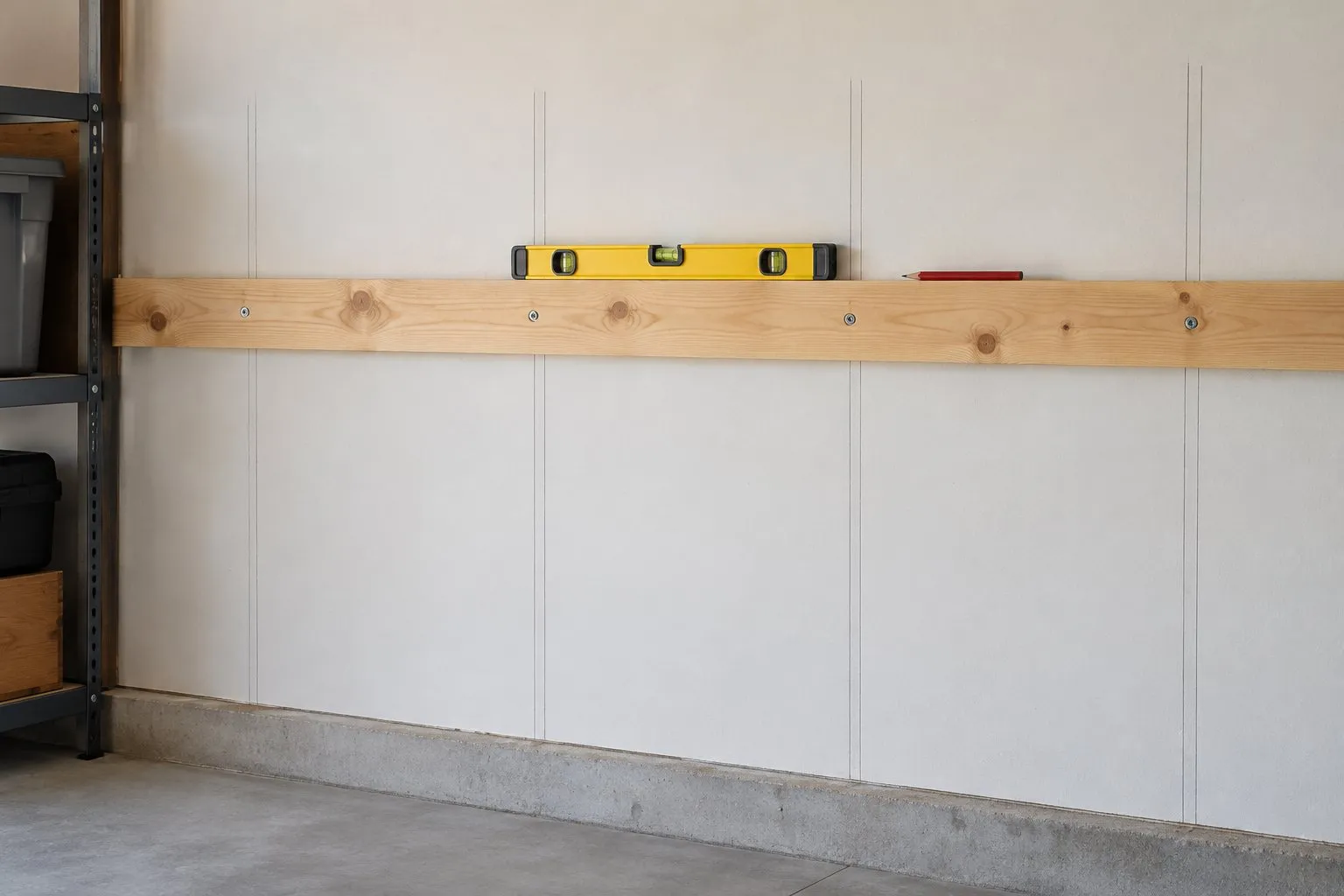
- Onto a ledger board screwed across at least two studs, if the brackets cannot reach studs. Wood studs are 16 or 24 inches on center, so a narrow table may reach only one.
- Into brick or concrete with the anchors the manual names; Mount-It! warns not to drill into the mortar between bricks.
Adding hollow-wall anchors next to the old holes does not solve the problem: TOGGLER's sheet notes that industry standards recommend one quarter of the ultimate test load as the working load, and it measures failure in drywall as the board starting to break. The question can you mount a folding table on drywall without studs explains the ledger option, and the guide on how to install a wall-mounted folding table covers remounting step by step.
Cause 4: the brackets are not level
If one bracket sits higher than the other, the top rests on one arm, twists and wobbles. It also stops one latch from engaging cleanly.
Fix: unload the top, check both brackets with a level, and reset the lower one in fresh holes in the same stud. Mount-It! also says to place the arms so that their front ends do not stick out past the front edge of the top.
Cause 5: too much load or too long a top
A load rating is the maker's figure for the table on a sound wall with the stated mounting – 33 lb for the Mount-It! MI-7993 on its own page, 66 lb for the COSTWAY drop-leaf, 110 lb for the VIVO workbench on wood stud, brick or concrete. Sugatsune adds for its folding brackets that the weight of the top itself counts against the load capacity. A top that bends between the brackets, or a load that sits at the front edge, is a sign the table is used beyond what it was made for.
Fix: keep heavy items close to the wall and within the maker's rating. Do not sit on the top or stand on it. Why the fixing rather than the table usually sets the limit is explained on the page about weight capacity.
Cause 6: no gap to the wall
The top must be able to swing past the wall when it folds. VIVO asks for at least 3/8 inch (10 mm) between the back of its top and the wall; Sugatsune notes that the top must be lifted slightly to fold the bracket closed. Without that gap the top binds, the latch cannot release or engage cleanly, and the brackets get forced.
Fix: loosen the screws that hold the top to the brackets, slide the top forward to create the gap and tighten again.
When to call a professional
Call a carpenter or handyman if the wall is damaged around the screws, if you cannot find studs where the table has to go, if the wall is plaster and lath or steel studs, or if you are unsure what is behind the drywall – cables and pipes can run where you want to drill. The makers say the same: VIVO's manual asks you to call a qualified technician if you have any doubts about the safety of the installation.
When a new table makes more sense
If the brackets are bent, a latch is broken or the top has split around the screws, replace the table rather than patch it. For bracket-only builds, new brackets of the right length are covered in the folding shelf brackets guide. For a ready-made replacement, pick one whose maker names the wall it is rated for:
VIVO 43 x 18 Workbench
A 43-inch workbench top on steel brackets that folds to 2.3 inches from the wall.
Why here: VIVO states 110 lb on wood stud, brick or concrete and explains in its manual how many holes go into each stud – the clearest mounting data among the bracket tables we compared.
Best for: Garages and basements with wood studs, brick or concrete walls
- VIVO names the wall types: wood stud, brick or concrete
- 110 lb capacity stated by the maker
- Folds to 2.3 in from the wall
- 3-year warranty (VIVO)
- Particle board top – not for wet work or heavy pounding
- Type
- Top on folding steel brackets
- Top size
- 43.3 x 18 x 1 in
- Load rating
- 110 lb (VIVO)
- Mounting
- Wood stud, brick or concrete (VIVO)
- Folded depth
- 2.3 in (VIVO)
- Warranty
- 3 years (VIVO)
All models with their stated load and mounting are in the comparison of the best wall-mounted folding tables. More guides start on the homepage.
Questions people ask
Why does my fold-down table tilt down at the front?
Most often because the upper screws are pulling away from the wall or a latch is not fully engaged. The load on the top acts like a lever on the upper screws, and the further out it sits, the harder they are pulled. Unload the table, check that both latches lock and that the upper screws are tight and sit in a stud or ledger board.
My fold-down table will not lock in the open position. What can I do?
Raise the top fully until both latches engage; VIVO describes exactly that for its workbench, and Mount-It! says its arms latch at a 90-degree angle. If one side does not lock, check for something blocking the arm, a top that rubs on the wall, or a bracket that is not level with the other. Do not use the table until both sides lock.
Can I just add more screws or anchors to stop the wobble?
Only if they go into the same solid support: a stud, a ledger board screwed across studs, or brick or concrete with the anchors the manual names. More hollow-wall anchors do not fix a bracket in drywall alone; TOGGLER's sheet notes that industry standards recommend one quarter of the ultimate test load as the working load.
Sources
- VIVO: MOUNT-SF1FB instruction manual (PDF) – stud holes, gap to the wall, latches
- Mount-It!: MI-7993 user manual (PDF) – arm latch, bracket position, stud and masonry options
- Sugatsune: 388 Series – how to install heavy-duty folding shelf brackets (load, clearance, folding)
- IKEA (Canary Islands, English): NORBERG wall-mounted drop-leaf table – care note on re-tightening screws
- TOGGLER: SNAPTOGGLE technical bulletin (ultimate loads, 1/4 working-load note)
Keep reading
- ExplainerWeight capacityHow much weight a wall-mounted folding table can hold: maker load ratings from 33 to 150 lb, what the wall and anchors add, and why leverage limits the load.
- How-toHow to installInstall a wall-mounted folding table safely: find the studs, mark the top edge, drill per the manual and use a ledger board when the brackets miss a stud.
- Buying guideFolding bracketsFolding shelf brackets for a DIY fold-down table or workbench: which arm length fits your top, how to read load ratings, and how to land every bracket on a stud.
- Question & answerCan You Mount a Fold-Down Table on Drywall Without Studs?Can a fold-down wall table hang on drywall without studs? Why hollow-wall anchors are the weak point, and how a ledger board across the studs solves it.
- ComparisonAll tables comparedThe best wall-mounted folding tables, desks and workbenches side by side: top size, load rating with the mounting it assumes, folded depth and maker sources.
Who writes here
wallmountedfoldingtable.com Editorial Team
Fold-down tables, desks & workbenches
We are the editorial team at wallmountedfoldingtable.com. We compare maker spec sheets, manuals, retailer data, building codes and anchor data for wall-mounted folding tables and turn them into plain-English advice – with sources on every page. We do not run lab tests or load tests, and we say so openly.
- Maker specs, manuals & codes compared
- Sources on every page
- No lab tests – stated openly
- Publisher details in the imprint